Xiaomi 18 Fold debuts wider form factor and proprietary processor
Developed over time first seen 2 months ago
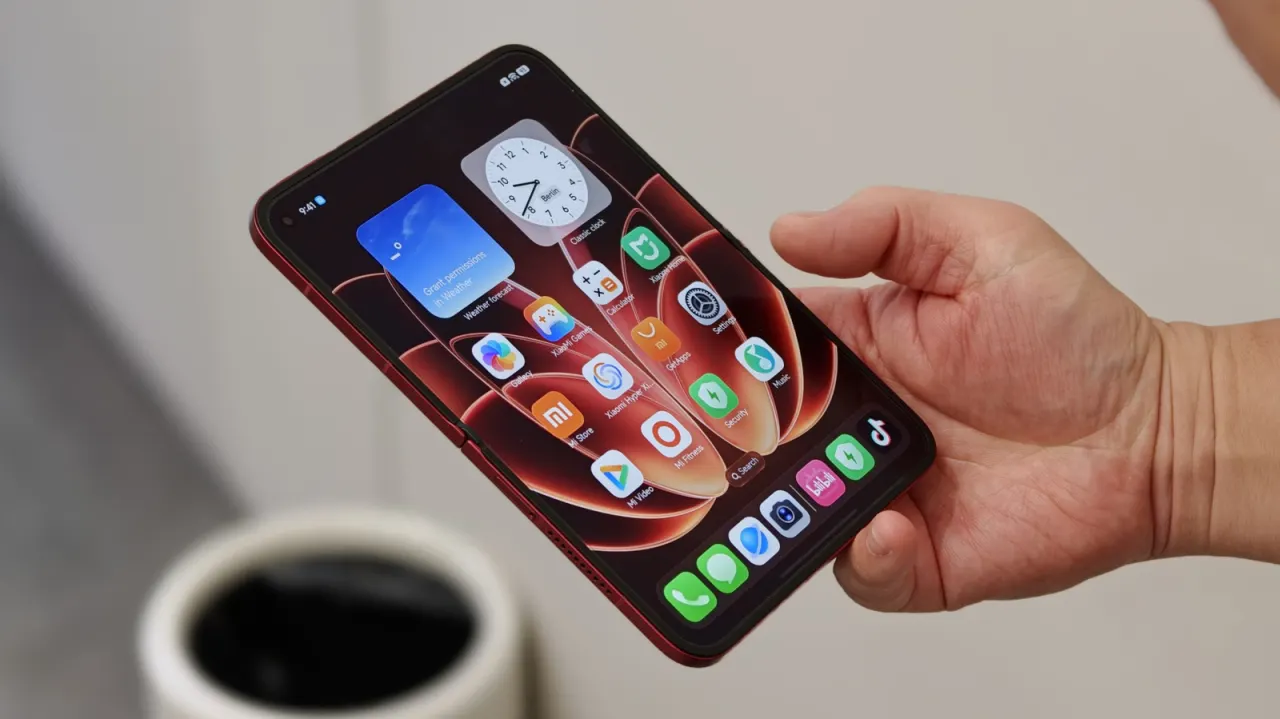
Xiaomi has unveiled the 18 Fold, a book-style foldable phone with an unusually short, wide form factor, previewed by The Verge at IFA ahead of Apple's own rumoured foldable launch this week. It is Xiaomi's first book-style foldable since 2024's Mix Fold 4 and follows Huawei and Samsung in adopting a squatter design, but goes further still: its roughly 1.4:1 aspect ratio, shared by both the 7.58-inch inner and 5.38-inch outer screens, closely matches standard paper sizes and IMAX cinema proportions. Compared with Samsung's Galaxy Z Fold 8, it is pocketable and comfortable to use one-handed when closed, though it is somewhat heavier, thicker, has no stated IP water-resistance rating, and shows a more visible hinge crease; Oppo's Find N6 remains the benchmark for minimising the fold crease.
The phone debuts Xiaomi's own Xring O3 chipset, said to match Qualcomm's Snapdragon 8 Elite, paired with Arm's new Mali G2-Ultra NX GPU offering DLSS-style graphics acceleration on Android. It packs a 6,000mAh silicon-carbon battery (versus 4,800mAh in the Z Fold 8) with 67W wired and 50W wireless charging, OLED screens reaching 4,000 nits, and a Leica-branded triple rear camera comprising a 200-megapixel main sensor, a 50-megapixel 3.5x periscope telephoto and a 50-megapixel ultrawide. It comes in black, white and red, plus a limited pink ceramic edition capped at 1,500 units.
- Sources
- 2
- Outlets
- 2
- Left · Centre · Right
- 0 · 0 · 0
In short
- Xiaomi's 18 Fold is a short, wide book-style foldable unveiled at IFA
- Features Xiaomi's own Xring O3 chip and triple 200MP Leica camera
- Bigger battery and brighter screens than Samsung's Galaxy Z Fold 8, but no IP rating
How this story developed
- 2 months ago Reporting on the device has refined its specifications, giving the inner display as 7.68 inches rather than 7.58 and citing a 219-gram weight, while framing the 18 Fold as a mid-range model that trades some flagship pricing for a lighter, more pocketable build than rivals.
- 2 months ago Xiaomi has unveiled the 18 Fold at IFA, a squat, wide book-style foldable with paper-matching proportions, a new Xring O3 chipset, a 6,000mAh battery and Leica-developed triple cameras, launching ahead of Apple's rumoured foldable debut.
Full account
Xiaomi has formally unveiled the Xiaomi 18 Fold in China, a book-style foldable that adopts the shorter, wider "squat" proportions now favoured by rivals such as Samsung and Huawei. The launch lands in the same week that Apple is widely expected to reveal its own first foldable iPhone, and journalists who handled the device at IFA drew immediate comparisons with Samsung's Galaxy Z Fold 8. Xiaomi describes the 18 Fold as its first "mid-size" foldable and its first book-style model since the Mix Fold 4 of 2024.
Both the inner and cover displays share a squashed, near-A4 proportion — one outlet measured the folding screen at 7.68 inches while another put it at 7.58 inches, though both agree the cover display measures 5.38 inches. The ratio is close enough to standard paper sizes and IMAX screens that reviewers noted it suits reading and video playback particularly well. At 219g, Xiaomi says it is the lightest foldable it has built, and the cover screen has an unusual asymmetric shape, with rounded corners on the outer edge and squared-off corners near the hinge. The phone is offered in black, white and a striking red, alongside a limited pink ceramic edition capped at 1,500 units. Opinions differed on build quality: one hands-on account praised the redesigned three-link hinge as feeling notably sturdier than competitors', while another felt the crease was more pronounced than on this year's Samsung foldables, noted that the 18 Fold is thicker and heavier than the Z Fold 8, and pointed out that Xiaomi has not published any IP water- or dust-resistance rating for the device.
The 18 Fold is the first Xiaomi flagship to run the company's own in-house chip, the XRING O3, built on a 3nm process with a ten-core all-big-core CPU and a 16-core GPU. Xiaomi claims it is the first chip to support LPDDR6 memory and that it offers roughly 45 percent faster on-device NPU decoding than the previous generation. The phone also carries a large silicon-carbon battery, which Xiaomi claims is the biggest yet fitted to a foldable, supported by 67W wired and 50W wireless charging.
On imaging, Xiaomi has fitted a Leica-branded triple rear camera system built around a 200-megapixel main sensor alongside a 50-megapixel periscope telephoto lens, with reviewers noting Xiaomi appears less willing than Samsung to compromise on camera hardware for the sake of a slimmer body. Screen technology is shared across both panels, with a new "HyperRGB" subpixel structure, peak brightness of 4,000 nits and adaptive 1-120Hz refresh rates, wrapped in an aluminium frame with Xiaomi's own Shield Glass 3.0 protection. Coverage so far has been based on brief hands-on time at IFA rather than extended testing, so aspects such as camera performance and everyday durability remain to be independently verified.
Where outlets differ
From the full account, which is AI-written from the sources:
The two accounts give slightly different inner-screen measurements (7.68in vs 7.58in), though both agree on the 5.38in cover screen.
One report is largely positive about the hinge and overall feel, calling it stronger than rival hinges, while the other is more critical of build quality, highlighting a more visible crease, extra thickness/weight versus the Galaxy Z Fold 8, and the lack of any announced IP rating.
One outlet focuses heavily on the new XRING O3 chip, battery and camera specifications, while the other centres its account on the form factor, design, colourways (including the limited pink ceramic edition) and usability impressions, with only brief mention of internal specs.
Only one source explicitly references Oppo's Find N6 as the current benchmark for minimising the foldable crease.
Explained simply
Xiaomi's 18 Fold is a "book-style" foldable phone, meaning it opens like a small book to reveal a larger inner screen, while a smaller outer screen is used when it's closed. This type of device sits opposite "flip" foldables that open vertically, and rivals from Samsung and Huawei have been refining the format for several years. Xiaomi is one of the world's biggest phone makers, based in China, and has released earlier folding models before this one.
The wider, shorter shape and processor choice matter because foldable phones are still a young category where manufacturers are experimenting to fix common complaints, such as devices being too narrow, heavy or fragile when closed. Xiaomi has also historically relied on chips from outside suppliers like Qualcomm, so building its own processor marks a shift towards more in-house technology, echoing moves other large phone makers have made to reduce reliance on external chipmakers.
The broader context is a competitive period for foldable phones, with several major manufacturers unveiling new models around the same time, including at trade events like IFA, and with Apple reportedly preparing to enter the category. This makes new releases from established players like Xiaomi relevant to a wider debate about how the foldable phone market is developing and who is leading its design direction.