Technology news and discussion on TalkFuse.
Google Earth risked ruin with retracted AI tool for making fake satellite pics
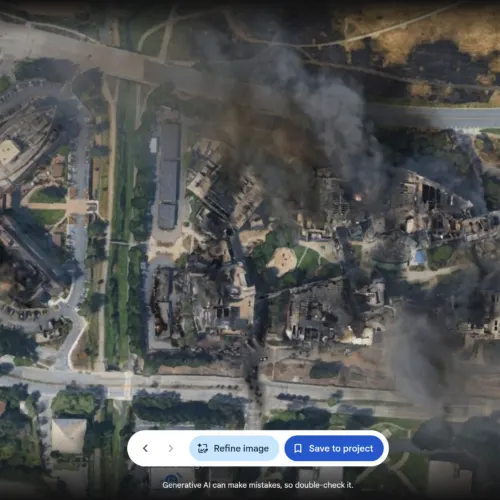
Google briefly introduced an AI feature in Google Earth that let users alter its satellite, aerial and 3D imagery with the Nano Banana 2 image generator, then withdrew it within a day. Critics warned that combining AI edits with a widely trusted mapping and verification tool could make convincing misinformation easier to create and spread, undermining confidence in authentic location imagery.
Google had promoted possible uses such as visualising completed building projects and reconstructing ancient Pompeii, but investigators quickly generated false scenes including refugees near the Mexican border, a nuclear plant in Iran and a fatal crash in Amsterdam. Bellingcat founder Eliot Higgins and investigator Henk van Ess said the tool could reduce a previously multi-step forgery process to seconds; Google initially cited SynthID watermarks on generated images before making the feature inaccessible.
In short
- Google withdrew an AI satellite-image editing feature within a day.
- Researchers warned it could rapidly enable convincing location-based misinformation.
- Google initially relied on SynthID watermarks as a safeguard.
Steelman: both sides, in good faith
The strongest fair case each way — we don't pick a winner.
The case for
The tool offered genuine benefits for urban planning, architectural visualisation, historical reconstruction and education. AI-assisted image editing is technically inevitable and will be developed regardless of Google's actions. The swift withdrawal demonstrates that Google listened to concerns and took responsibility. The real solution involves developing better verification methods, digital literacy, and detection tools rather than attempting to prevent such technology entirely, which would sacrifice valuable applications across multiple fields.
The case against
Google Earth's status as a trusted source for verification makes it uniquely dangerous to introduce uncontrolled AI editing capabilities. The tool transformed a complex, time-consuming forgery process into seconds of work, dramatically lowering barriers to creating convincing misinformation. Even a quick withdrawal cannot restore confidence in the platform's integrity or undo the normalisation of AI-edited imagery passing as authentic documentation. This matters acutely for conflict monitoring, humanitarian response, and journalistic verification where location data authenticity is critical infrastructure.
Explained simply
Google Earth lets people explore satellite, aerial and 3D views of places around the world. Google added an AI image tool that could change those views, including to show imagined buildings or historical scenes, but users found it could also create realistic-looking scenes of events that had not happened.
The concern is that people often rely on location imagery when checking claims about places and events. If altered images are hard to distinguish from genuine ones, they could mislead viewers and weaken trust in mapping and investigations; watermarks are one way to identify AI-made images, though they may not settle every question about an image’s authenticity.
AI Art Culture Space Technology