Apple desktop refresh brings M5 Ultra and M6 in September 2026
Developed over time first seen 2 months ago
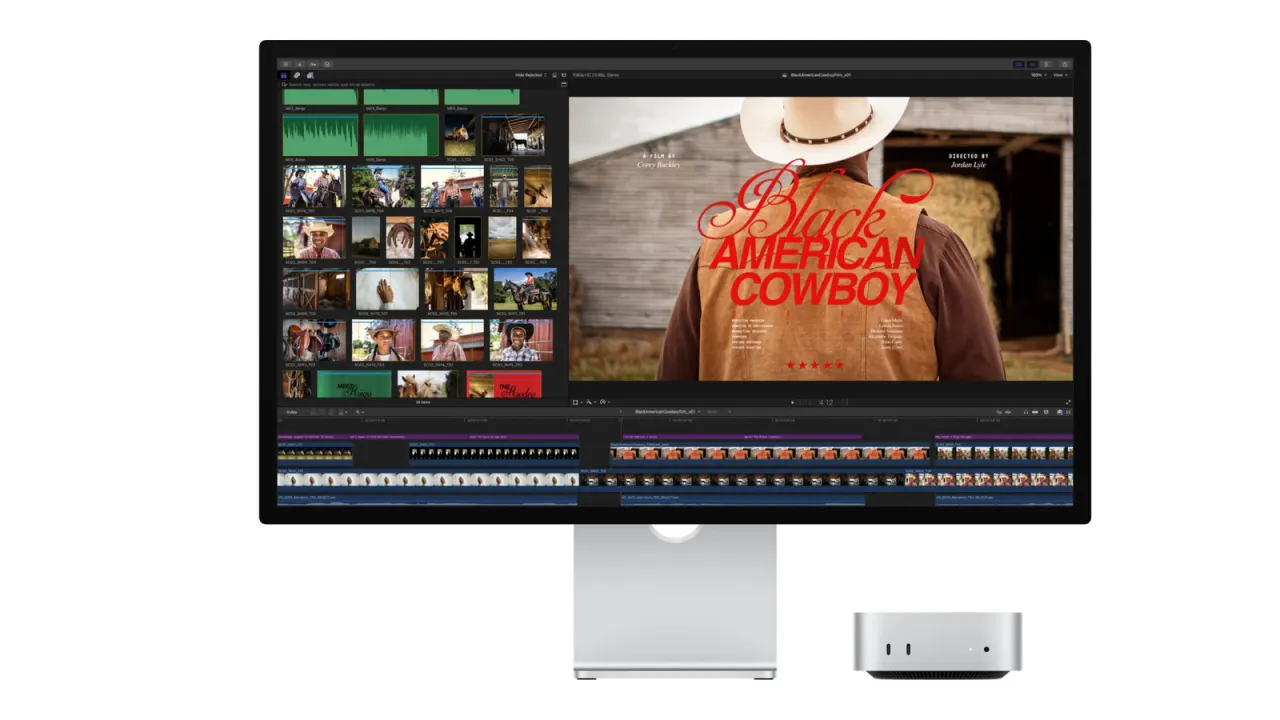
Apple has detailed how its new M5 Ultra chip, launched for the latest Mac Studio, compares with the outgoing M3 Ultra, revealing a redesigned "quad-die" architecture that fuses two dual-die M5 Max chips together — a first for Apple silicon, replacing the previous two-Max-die design. This matters because the Ultra chip targets professionals doing demanding 3D rendering, video editing and running large AI models locally, and the redesign, alongside a new M6 chip for a refreshed Mac Mini, represents Apple's biggest desktop silicon upgrade in years, with both machines due in September 2026.
The M5 Ultra offers up to 36 CPU cores (12 "super" plus 24 performance, versus 24 performance and eight efficiency cores previously), delivering roughly 25% faster single-threaded and up to 30% faster multithreaded performance than the M3 Ultra, alongside a jump in die-to-die interconnect speed to 4.4TB/s. Both chips support up to 512GB of unified memory, though the M5 Ultra raises memory bandwidth by 50% to 1.2TB/s, with the top 512GB configuration expected in October at around $15,000. The 80-core GPU has been redesigned with Neural Accelerators for up to 4.5 times faster AI performance and up to 40% faster graphics, while the Media Engine now handles 33 simultaneous 8K ProRes streams (up from 24) and storage moves to faster PCIe Gen 6 SSD architecture.
- Apple's M5 Ultra fuses four dies together for the first time
- Up to 36 CPU cores, 30% faster than the M3 Ultra
- M5 Ultra and M6 chips arrive in Mac Studio and Mac Mini in September 2026
New here? Start with this
Apple has released updated versions of two of its desktop computers, the Mac Mini and Mac Studio, both of which are built around Apple's own processor chips rather than parts made by outside suppliers such as Intel. These new versions use the latest generation of Apple's chips, including a brand-new model called the M6 and a more powerful variant called the M5 Ultra, which combines several processors into one unit to boost performance.
These machines are aimed largely at professionals with demanding computing needs, such as those working with artificial intelligence, 3D graphics or high-resolution video editing, since more processing power lets them handle bigger, more complex tasks more quickly. Apple regularly updates its computer chips on a roughly yearly cycle, and each new generation typically brings faster performance and other technical improvements, though the outward design of the computers often stays much the same.
The update matters because it shows how Apple continues to develop its own chip technology to compete with rivals, and because changes like these affect what professional and business customers can expect to pay for high-performance computing equipment.
Full account
Apple has refreshed its desktop line-up with two new custom processors, the M6 and the M5 Ultra, alongside updated Mac Mini and Mac Studio machines built around them. Both computers are open for preorder, with most configurations due to begin shipping on 22 September 2026 running the new macOS 27 release. The launch lands just weeks before Apple's traditional autumn iPhone event, and the company has pitched the new machines chiefly on artificial-intelligence performance and improved networking, alongside a raft of comparative performance claims against the outgoing M4-based models.
The entry-level Mac Mini now runs on the M6 chip and starts at $899, a jump of a few hundred dollars over the previous M4 base model, a rise several reports attribute to the wider run-up in memory prices affecting the whole industry. The M6 is Apple's first chip built on a 2-nanometer manufacturing process and features a 12-core CPU arrangement (two so-called 'super' cores, four performance cores and six efficiency cores), a 12-core GPU with a neural accelerator built into every core, and a 32-core Neural Engine that Apple says roughly doubles on-device AI throughput versus the M5. Buyers wanting more headroom can instead configure the Mini with the M5 Pro, the same chip already seen in the latest MacBook Pro, for $1,699; this variant supports more memory and faster Thunderbolt 5 ports, whereas the standard M6 model tops out at 32GB of RAM and sticks with Thunderbolt 4. Both versions gain Wi-Fi 7, Bluetooth 6 and 2.5Gb Ethernet as standard, though the Mini's external design is unchanged.
At the top end, the Mac Studio returns to using a single generation of chips after last year's unusual split between the M4 Max and the older but more powerful M3 Ultra. The new Studio starts at $2,499 with an M5 Max chip, 36GB of unified memory and 512GB of storage, matching the previous Max-based model's price. A new M5 Ultra option starts at $5,499 with 96GB of memory and 1TB of storage, rising to a 512GB memory configuration that Apple says will not ship until late October, with pricing for that model still unannounced. The M5 Ultra is built by fusing two dual-die M5 Max chips into a 'quad-die' package via Apple's UltraFusion interconnect, a configuration the company has not used before, and Apple is marketing it as its most powerful chip yet. Depending on configuration, it offers up to a 36-core CPU and an 80-core GPU, memory bandwidth of up to 1.2TB/s, and claimed AI compute gains of roughly 4.3 to 4.5 times over the outgoing M3 Ultra.
Coverage of the announcement diverges mainly in tone and focus. Some outlets concentrate on practical buying advice and pricing, framing the increases squarely against Apple's recent broader price rises and tight base storage allowances, while others dwell more on the underlying engineering, including reports that Apple intends to skip Pro and Max variants of the M6 entirely and move straight to an M7 chip by around mid-2027. There is also some inconsistency in how the Mac Mini's price rise is described, with figures cited ranging from roughly $100 to $300 more than earlier models depending on which prior baseline is used for comparison. Beyond the headline chips, most accounts agree the changes to the machines themselves are otherwise incremental refreshes of familiar designs, with faster storage and updated wireless standards rather than any change in form factor.
Where outlets differ
Coverage of the Mac Mini price increase varies: one outlet compares the $899 starting price to the 2024 M4 base model (a $300 rise), while another compares it to a more recent, already-hiked price point (roughly $100 more) and separately flags that the base storage remains a stingy 256GB.
Only one source situates the Mac Studio launch in the context of last year's awkward split between the M4 Max and M3 Ultra chips, framing this refresh as a 'reunification' under one chip generation; others simply report the new specs without that historical framing.
Technical depth differs sharply: one report goes into detailed architecture (UltraFusion interconnect speeds, core counts, Media Engine and codec support, and Apple's reported plan to skip M6 Pro/Max and jump to M7 by 2027), while the more consumer-facing pieces stick mainly to pricing and headline performance claims.
Framing of the price rises differs: some coverage attributes higher prices squarely to industry-wide memory cost increases ('RAMageddon'), with a notably more critical tone, while other accounts report the pricing more neutrally as simple like-for-like comparisons.
Coverage
- The Verge — Where to preorder the updated Mac Mini and Mac Studio
- Engadget — Apple upgrades Mac mini and Studio chips amid price rises
- Engadget — Apple’s M5 Ultra with an 80-core GPU will power through your AI models and 8K video
- The Verge — Apple launches new Mac Studios with its ‘most powerful chip ever’ — the M5 Ultra
- The Verge — Apple’s new Mac Mini has fresh M6 and M5 Pro chip offerings — and higher prices
- The Verge — Apple’s new M6 chip gets more cores and more AI compute
AI Art Celebrity Culture Entertainment Gadgets Software Technology