These Cyborg Cockroaches Could Save Your Life
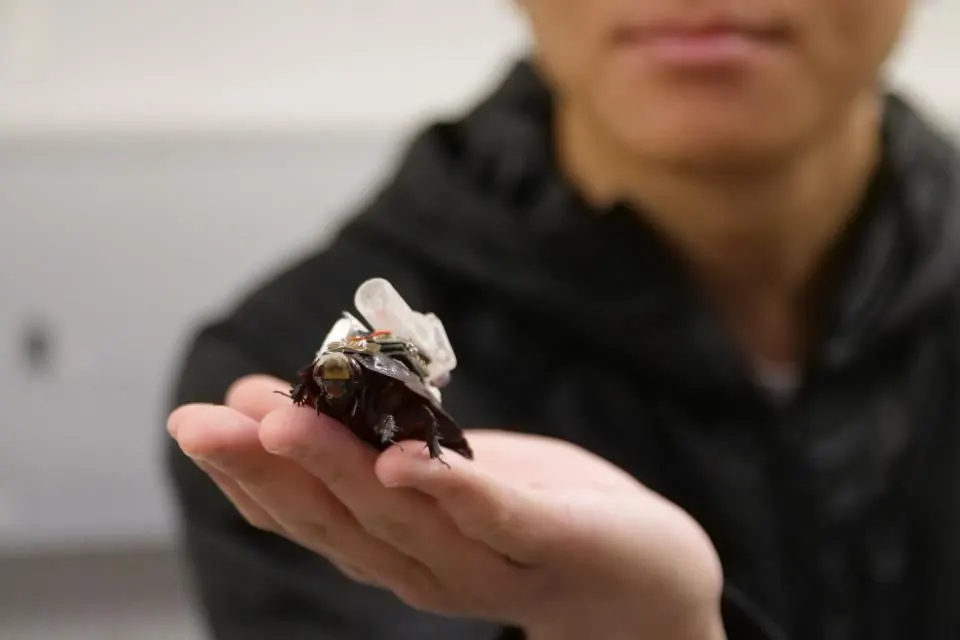
Researchers at the University of Queensland (UQ) and the University of New South Wales (UNSW) have created a cyborg cockroach, dubbed the "Paraborg," designed to assist in disaster response by searching for survivors and administering first aid. Unlike earlier cyborg insects built mainly for reconnaissance, this project pushes the technology further by equipping the insects to actively deliver medical help, potentially buying rescuers crucial time before human teams can reach victims trapped in debris or unstable structures.
The team used a giant burrowing cockroach native to northern Queensland, which can grow up to 87 millimetres long and weigh 40 grams, fitting it with electrodes on its antennae and cerci to remotely steer its direction and speed. Two versions were built: one carrying a camera to assess victims' conditions, and another fitted with a spring-and-chemical-reaction injection mechanism to deliver medication, using a citric acid and baking soda reaction to push a syringe plunger. In tests, close-range injections succeeded roughly 95% of the time, while the full task sequence had a 72% success rate, and researchers also showed two cockroaches could work as a team, with one locating a target and the other administering the injection. The work, published in Advanced Science, has not yet been tested in realistic disaster conditions, but lead researcher Tan Vo Doan hopes such insect rescue teams could be deployed in the field within five to ten years.
In short
- Scientists built cyborg cockroaches to aid disaster search and rescue efforts
- They can film victims and self-administer injections via remote control
- Field deployment could be possible within five to ten years, researchers say
Steelman: both sides, in good faith
The strongest fair case each way — we don't pick a winner.
The case for
Paraborgs could reach people in unstable or inaccessible debris before human rescuers can safely enter, potentially helping victims survive by identifying urgent needs and delivering treatment sooner. Their small size and ability to work as a team may complement rescue crews, while the reported test results offer an early basis for further development.
The case against
The reported trials do not show whether the system would work reliably amid rubble, dust, unpredictable movement or the time pressures of a real disaster, and a 72% success rate for the full task sequence leaves substantial room for failure. Remote medication delivery also raises questions about choosing an appropriate treatment and avoiding harm, so deployment would need strong safeguards and evidence that it improves on existing rescue methods.
Explained simply
Search-and-rescue teams can struggle to reach people trapped in rubble or unsafe buildings. Small devices that can move through narrow gaps could help locate victims and, in some cases, provide help before rescuers arrive.
Researchers at the University of Queensland and the University of New South Wales have developed a system that remotely guides a large burrowing cockroach fitted with electronic equipment. The project builds on earlier work using insects for reconnaissance, adding the possibility of carrying a camera or delivering medicine.
The research is at an early stage, and the insects have not been tested in real disaster conditions. Its potential matters because even a short delay in reaching an injured person can affect what help they receive.