France and Korea Launch $1.16 Billion Screen Industry Financing Partnership at Lumiere Summit
Developed over time first seen 2 months ago
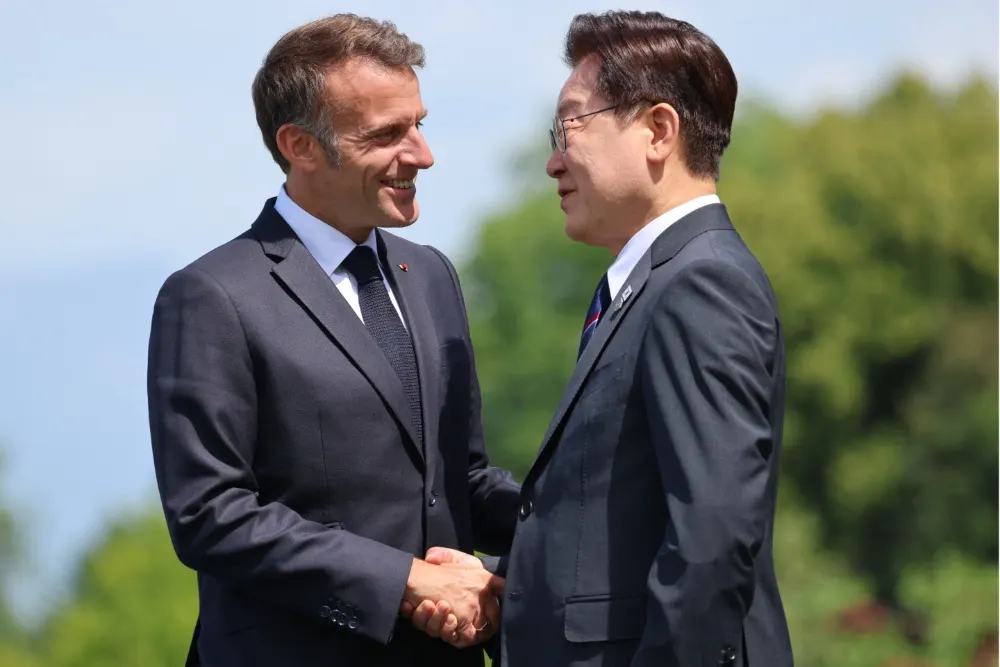
France and Korea have formally launched the Lumière Partnership, a €1 billion ($1.16 billion) joint fund to strengthen their screen industries, unveiled at the Lumière Summit in Saint-Paul-de-Vence and co-chaired by Presidents Emmanuel Macron and Lee Jae-myung. Each country is contributing €500 million, with the first funding instruments deploying between 2027 and 2031, and the partnership prioritising companies with the scale and ambition to compete internationally; it remains open to further countries joining. It matters as a deliberate state-backed push to build globally competitive film, television and animation firms, arriving alongside fresh figures showing France's inbound production spending nearly doubling this year.
France's share will run through public investment bank Bpifrance, working with the CNC, which has already fast-tracked almost 150 companies via its French Touch plan; the money will fund equity stakes, R&D and creative-innovation grants, and risk-sharing co-financing with banks and private investors, all aligned with summit principles putting human creativity first and committing to copyright protection and cultural diversity. The announcement coincided with data showing international productions have committed €628.5 million to French spending since January 2026 — split across fiction, animation and visual effects — with the year-end total expected to reach roughly €1 billion, about double last year's figure, driven by enhanced tax incentives and the "Grande Fabrique de l'Image" studio-expansion programme; the Lumière Partnership was one of several commitments to emerge from a summit attended by 300 participants from over 60 countries.
- Sources
- 2
- Outlets
- 2
- Left · Centre · Right
- 0 · 0 · 0
In short
- France and Korea launch €1bn Lumière Partnership to boost screen industries
- Each nation pledges €500m; funding runs 2027–2031
- Comes as France's inbound production spending nearly doubles this year
How this story developed
- 2 months ago France and Korea have unveiled the full details of the Lumière Partnership, a €1 billion ($1.16 billion) joint fund to strengthen their screen industries, announced at the Lumière Summit in Saint-Paul-de-Vence and co-chaired by Presidents Emmanuel Macron and Lee Jae-myung.
- 2 months ago France and Korea have each pledged €500 million ($581 million/£434 million) to a new joint fund, the Lumière Partnership, aimed at strengthening their screen industries and helping companies compete internationally.
- 2 months ago France and Korea have formally launched the Lumière Partnership, a €1 billion ($1.16 billion) joint fund to strengthen their screen industries, unveiled at the Lumière Summit in Saint-Paul-de-Vence and co-chaired by Presidents Emmanuel Macron and Lee Jae-myung.
Full account
France and South Korea have agreed to jointly commit €1 billion (roughly $1.16 billion) to a new fund supporting the global screen industries, in what organisers are calling the centrepiece announcement of the Lumière Summit held on Monday in Saint-Paul-de-Vence, in the south of France. Each country is putting up €500 million ($581 million), with the first financing instruments due to be deployed between 2027 and 2031. The scheme, named the Lumière Partnership, has been left open to other nations wishing to join, provided they sign up to its stated principles, among them that human creativity should come first, alongside commitments to copyright protection and cultural diversity.
The summit was co-chaired by French President Emmanuel Macron and his South Korean counterpart, Lee Jae-myung, who is currently on a four-day state visit to France. Macron, writing in an op-ed for Variety, framed the partnership as proof that openness to international markets need not come at the expense of a country's distinctive creative identity, pointing to France and Korea as two nations that have taken different routes to the same conclusion. Lee, whose country has become a major force in global entertainment through hits such as Squid Game and the multiple Oscar-winning film Parasite, said Korea intended to lead the way in producing content capable of resonating across borders and languages.
On the French side, the funding will be administered by Bpifrance, the state investment bank that has supported the country's cultural and creative sectors since 2020 and, in partnership with the Centre national du cinéma et de l'image animée, has already helped fast-track close to 150 companies through its French Touch initiative. Under the new partnership, money will be deployed through equity investment in companies with the scale and ambition to compete internationally, funding for research and creative development, and co-financing arrangements intended to share risk with banks and private investors. The announcement was paired with figures showing a marked rise in international productions choosing to film in France this year, with commitments reportedly totalling around €628.5 million (about $730 million) since January across fiction, animation and visual effects work, a figure expected to approach €1 billion by the end of 2026 — roughly double the previous year's total — with projects ranging from British and American productions to those from Belgium, Italy, Egypt and Indonesia using studios across the country.
The one-day gathering, named after the pioneering French film-makers Auguste and Louis Lumière, drew more than 200 to 300 figures from the international film and television world to the town long associated with artists including Matisse, Chagall and Picasso. Attendees said to be present included actor and director George Clooney, Netflix co-chief executive Ted Sarandos, NBCUniversal Entertainment chairperson Donna Langley, CAA's Bryan Lourd, and senior French industry figures such as Mediawan co-founder Pierre-Antoine Capton, Canal+ Group chief executive Maxime Saada and Cannes Film Festival director Thierry Frémaux. Organisers described the financing pledge as one of several concrete outcomes of the summit, which they said had brought together participants from more than 60 countries to discuss the future of the moving image.
Where outlets differ
From the full account, which is AI-written from the sources:
Variety's report leans heavily on the financial architecture of the deal — detailing Bpifrance's role, the specific investment instruments (equity, R&D funding, co-financing), and separate statistics on France's booming inbound production market — none of which appears in Deadline's account.
Deadline instead foregrounds the summit's star power and setting, listing high-profile attendees such as George Clooney, Ted Sarandos and Donna Langley, and dwelling on Saint-Paul-de-Vence's artistic heritage (Matisse, Chagall, Picasso), details Variety omits entirely.
Deadline includes a direct quote from President Lee Jae-myung about Korea's ambitions in global content, and notes he is on a four-day state visit to France, context absent from the Variety piece.
The two sources give slightly different attendance figures for the summit — Variety cites 300 participants from over 60 countries, while Deadline cites more than 200 high-profile figures — suggesting different counting methods (overall delegates vs. notable guests).
Steelman: both sides, in good faith
The strongest fair case each way — we don't pick a winner.
The case for
Supporters see the Lumière Partnership as a sensible industrial strategy: by pooling €1 billion in patient, state-backed capital, France and Korea can help their studios reach the scale needed to compete with dominant American and global streaming players, while safeguarding jobs, technical expertise and cultural output that pure market financing tends to under-fund. They argue that public co-investment through vehicles like Bpifrance, alongside tax incentives that have already drawn nearly €630 million in inbound production spending this year, demonstrates a track record of leveraging private money rather than replacing it, and that protecting principles such as human creativity, copyright and cultural diversity is a legitimate public interest, not mere protectionism, especially as AI reshapes the industry.
The case against
Sceptics would counter that channelling €1 billion of public money into a single sector risks distorting the market, favouring firms already large enough to be prioritised over smaller independents, and substituting political judgement for the price signals that normally allocate capital. They would question whether taxpayers should underwrite an industry whose success is inherently unpredictable, note that state-backed "national champion" strategies have a mixed record of producing globally competitive firms, and worry that tying support to broad goals like cultural diversity or copyright protection could be used to justify subsidies indefinitely, crowding out private investment rather than genuinely catalysing it.
Explained simply
France's Bpifrance-CNC pipeline has already screened companies through the "French Touch" scheme, and separate figures show inbound production spending in France is set to nearly double this year, partly thanks to beefed-up tax breaks and a new studio-expansion drive called "Grande Fabrique de l'Image." That context helps explain why the two governments see this fund as building on momentum already under way, rather than starting from scratch.
The Lumière Summit itself, held in Saint-Paul-de-Vence and drawing around 300 delegates from more than 60 countries, was also used to agree shared principles on protecting human creativity, copyright and cultural diversity in the screen sector, reflecting wider anxieties in the industry, including around artificial intelligence, that go beyond the France-Korea deal alone.
Coverage · 2 sources
Art Asia Culture Europe Geopolitics Politics World