Sturgeon backs Burnham to succeed, despite Swinney’s warning about his premiership
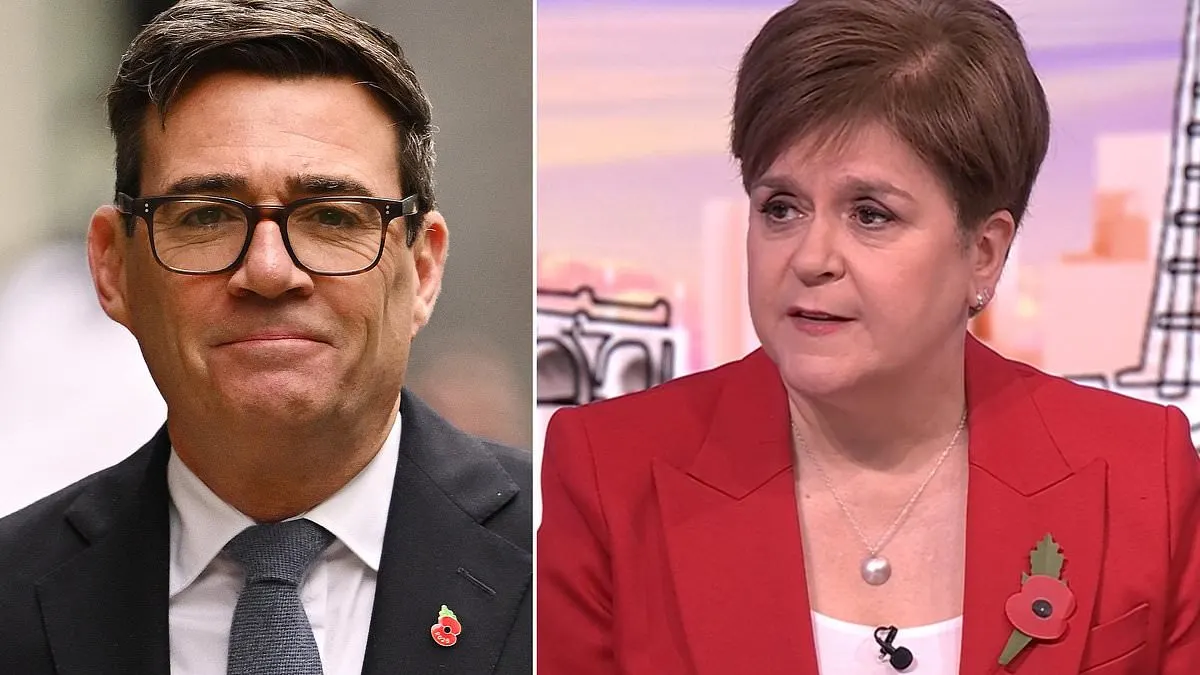
Nicola Sturgeon said she wanted Andy Burnham to succeed as Prime Minister, arguing that the whole UK would benefit if he delivered on his promises. Her comments came days after Burnham urged devolved leaders to work with the UK Government, and contrast with John Swinney’s claim that Burnham would be the UK’s last Prime Minister.
Sturgeon said Burnham had significant political goodwill but needed to use it to advance reforms, including social care and relations with the EU. She also criticised Chancellor John Healey’s Budget interview and said public anger could grow if further action did not follow. A poll cited in the article found 59 per cent of Scots did not believe Sturgeon had no knowledge of her husband Peter Murrell’s crimes; Murrell was jailed for five years and three months after admitting embezzling more than £400,000 from the SNP.
In short
- Sturgeon says she wants Burnham to succeed as Prime Minister.
- She says he must use his political goodwill to deliver reforms.
- A poll found 59 per cent of Scots doubted her account of Murrell’s crimes.
Steelman: both sides, in good faith
The strongest fair case each way — we don't pick a winner.
The case for
Sturgeon’s support can be seen as a pragmatic response to the opportunity for cross-party cooperation: if Burnham has political goodwill and is willing to pursue reforms such as improving social care and relations with the EU, his success could benefit people across the UK. Encouraging him may help build trust between the UK Government and devolved leaders and give voters reason to expect practical change.
The case against
Swinney’s warning reflects the view that Burnham’s approach may not address Scotland’s constitutional or political priorities, and that cooperation should not be mistaken for confidence in his premiership. Sturgeon’s endorsement could also be premature: goodwill and promises matter only if they lead to action, while public anger may rise if the Government fails to deliver.
Explained simply
Nicola Sturgeon and John Swinney are senior figures in the Scottish National Party, which supports Scottish independence. Andy Burnham is a senior Labour politician and Mayor of Greater Manchester; becoming Prime Minister would require him to lead the UK Government.
The UK is made up of England, Scotland, Wales and Northern Ireland, with some powers held by devolved governments and others by the government in Westminster. Disagreements over how those governments work together sit alongside wider debates about public services, the economy and the UK’s relationship with the European Union.
Sturgeon’s and Swinney’s remarks matter because they offer different views of Burnham’s political prospects and of what his leadership could mean for the UK. Social care is one of the services under discussion, and responsibility for it is shared across different levels of government.
Read the full article at the source →
Originally published by Daily Mail as “John Swinney said Andy Burnham would be the ‘last Prime Minister’… but Nicola Sturgeon admits she wants Labour leader to ‘do well’”.