Mars volcano cloud may reveal naturally forming ice without particles
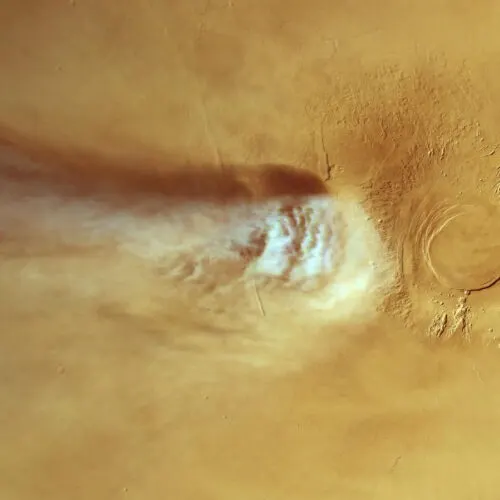
A study has modelled how a long, recurring cloud near Mars’s Arsia Mons volcano may form, offering an explanation for a phenomenon first recorded in 2018. The model suggests the cloud could result from homogeneous nucleation, in which water vapour turns directly into ice without dust or other particles. If confirmed, the process would be the first direct evidence of this kind of ice formation occurring naturally in a planetary atmosphere.
The cloud appears each morning during Martian spring and summer, grows to more than 1,000 miles long, then dissipates; the cycle continues for several months. The model links its formation to winds rising over the 65,000-foot volcano, which rapidly lift moist air and cool it by 30°C within 10 minutes. The proposed process also requires humidity more than 100,000 times higher than any level measured on Earth, and researchers say those conditions had not previously been known to exist on Mars.
In short
- A Martian cloud stretches more than 1,000 miles.
- A new model suggests it forms directly as ice.
- The process may be unlike anything observed in nature.
Explained simply
Arsia Mons is a giant volcano on Mars, and the planet’s thin atmosphere contains small amounts of water vapour. In Martian spring and summer, a long cloud appears near the volcano each morning, stretches across the sky and fades later in the day.
Scientists study how clouds form to understand the weather and atmosphere of other planets. One possible process, called homogeneous nucleation, is when water vapour freezes into ice without dust or other particles to start it. The proposed explanation depends on unusually humid air cooling very quickly as winds rise over the volcano.
If this process is confirmed, it would show that ice can form this way naturally in a planetary atmosphere. The extreme humidity involved would also add to scientists’ understanding of conditions on Mars.
Read the full article at the source →
Originally published by Ars Technica as “A 1,000-mile cloud on Mars may reveal physics never seen in nature”.