A Cray-1 supercomputer replica from 30 “obsolete” Mac Minis
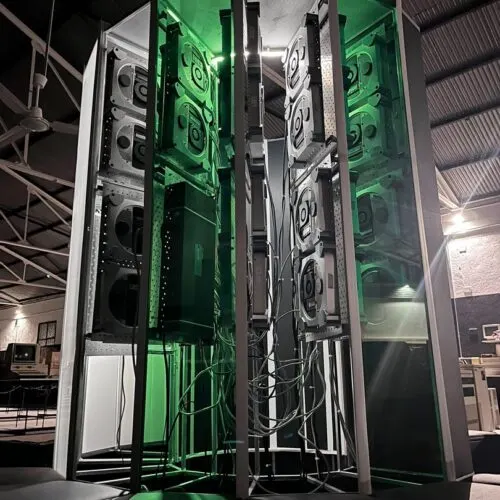
The Museo de Historia de la Computación in Spain has unveiled a full-scale replica of the iconic Cray-1 supercomputer from 1976, constructed using 30 second-hand Mac Minis from 2012–2014 rather than cutting-edge equipment. Completed over 18 months as a 50th-anniversary tribute to both the Cray-1 and Apple's founding, the project demonstrates how networked consumer hardware can vastly exceed the computational power of landmark machines from decades past.
The cluster comprises 25 dual-core i5 and five quad-core i7 Mac Minis running macOS Mojave with Message Passing Interface software to coordinate processing across nodes, achieving 1.3 teraflops of performance—thousands of times greater than the original's peak 160 megaflops. The design differs fundamentally in architecture: whereas the Cray-1 used vector processing, the replica distributes tasks across independent processors in parallel. Engineers solved thermal challenges through passive convection by vertically mounting components within a steel chassis, making the system operate nearly silently, and created a retro-styled control terminal mimicking 1970s computer-room aesthetics to manage the cluster.
- Spanish museum built full-size Cray-1 replica from 30 old Mac Minis
- Achieves 1.3 teraflops, far exceeding original's 160 megaflops
- Passively cooled design keeps system nearly silent
New here? Start with this
The Cray-1 was an iconic supercomputer built in 1976 that represented the pinnacle of computing speed of its era. It was revolutionary because it could perform calculations far faster than any other machine available, making it essential for scientists and engineers working on complex problems.
A Spanish computer museum has created a full-scale replica of the Cray-1 using 30 second-hand Mac Minis from the early 2010s, in tribute to the original machine's 50th anniversary. The project took 18 months to complete and demonstrates how multiple computers linked together can provide the same or greater capability as a dedicated supercomputer.
The replica shows how far technology has progressed: despite being made from ordinary, discarded computers, it can perform calculations thousands of times faster than the original Cray-1. This illustrates that the extraordinary calculating ability once exclusive to a rare supercomputer can now be achieved by combining everyday machines found in homes and offices.