Wingard’s Onslaught is visually sharp but narratively undercooked
Developed over time first seen 2 months ago
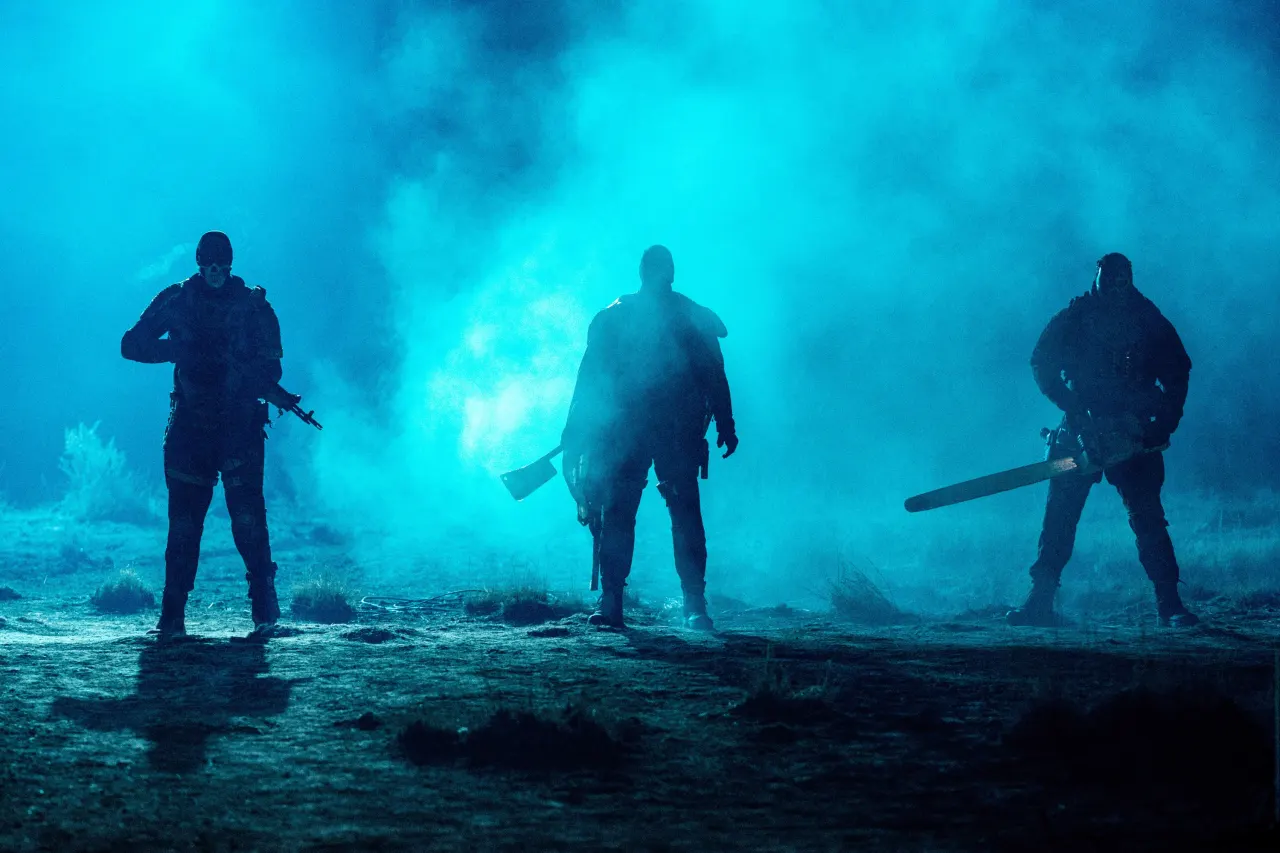
A review of Adam Wingard's action-thriller "Onslaught" concludes that the film is technically accomplished but let down by an underdeveloped story, particularly in its second half. Wingard, returning to original material after a decade working on established franchises, delivers striking visual set pieces and a home-invasion structure reminiscent of his earlier films "You're Next" and "The Guest", but the review argues he fails to build meaningfully on the promise of his opening scenes.
The plot follows Celeste (Adria Arjona), a PTSD-afflicted former Army sniper living in a remote desert trailer park, who must defend her daughter and neighbours when three near-indestructible super-soldiers escape a nearby military bunker. The review praises Oren Soffer's cinematography and Nick Interlandi's sound design, along with supporting turns from Dan Stevens as a Nazi scientist, Rebecca Hall and Drew Starkey, but notes that several characters and the film's hinted political themes around military-created horror are left frustratingly unexplored.
- Review calls "Onslaught" visually impressive but narratively thin
- Adria Arjona plays a PTSD sniper fighting escaped super-soldiers
- Strong craft and cast undercut by underused characters and themes
New here? Start with this
Celeste, played by Adria Arjona, is a former Army sniper struggling with PTSD who now lives quietly in a remote desert trailer park with her daughter. That fragile calm is broken when three near-unstoppable super-soldiers break free from a nearby military bunker, turning her home into the setting for a violent siege she must fight to survive.
The film is directed by Adam Wingard, known for earlier home-invasion and thriller films such as "You're Next" and "The Guest", and features a cast including Dan Stevens, Rebecca Hall, Drew Starkey, Reginald VelJohnson and Eric Wareheim. It also gestures towards real-world history, opening with imagery linked to the Abu Ghraib prison abuse scandal and the post-war US recruitment of Nazi scientists.
This matters to film audiences because it marks a high-profile new release from a director with a strong genre following, built around striking visuals and sound design, and because early critical reaction is shaping expectations of whether the film lives up to its ambitious premise.
Full account
Adam Wingard, the director behind the two most recent "Godzilla vs. Kong" blockbusters, returns to smaller-scale, original genre filmmaking with "Onslaught," an A24-released military-horror thriller reuniting him with regular collaborator, writer Simon Barrett. Reviewers frame it as a homecoming of sorts to the lean, violent style that made Wingard's name on films such as "You're Next" and "The Guest," following a decade largely spent on studio franchise work, including "Death Note" and the Kong pictures. Running roughly 92 minutes, the film is built around a ticking-clock structure that counts down towards a violent confrontation.
At the story's centre is Celeste, played by Adria Arjona, a former Army sniper suffering from PTSD who manages a remote desert trailer park largely populated by veterans and other loners, including a good-natured older neighbour, Josiah (Reginald VelJohnson), and the local sheriff, Kovacks (Eric Wareheim). Celeste's uneasy domestic routine, shared with her young daughter Daisy (Blake Kennedy), is disrupted when a trio of genetically or chemically enhanced super-soldiers escape from a nearby covert military facility. There, a Nazi-linked German scientist, Dr Hans Kammler (Dan Stevens), has been conducting brutal experiments on behalf of a private military contractor, apparently with the involvement of his wife, Hanna (Rebecca Hall). As the escaped soldiers cut a violent path across the surrounding towns, Celeste is eventually forced to defend her community when the carnage reaches her trailer park.
Both reviews broadly agree that "Onslaught" is a technically impressive but structurally uneven piece of work, echoing the sentiment captured in the headline description of the film as visually sharp but narratively undercooked. Critics praise its craftsmanship — inventive, gory action set pieces, striking sound design and cinematography, and vivid, memorable imagery — as the strongest evidence yet that Wingard has not lost his genre instincts after years away from smaller, original projects. However, both accounts also identify pacing and structural problems, noting that the film's various narrative strands are kept apart for too long and that the screenplay could have used further refinement, leaving a promising premise feeling underdeveloped by its conclusion.
The two reviews differ somewhat in what they emphasise. One concentrates on the film's fragmented structure, describing it as effectively three loosely connected films — Celeste's family drama, the military experiment plot, and a separate thread following a hitman (Drew Starkey's Cyrus) tasked with covering up the soldiers' rampage — arguing the third strand feels unnecessary and dilutes the main story; it also draws attention to the film's references to Operation Paperclip and Kammler's Nazi background, alongside racial undertones in the depiction of the experimented-upon soldiers, which it suggests remain deliberately unexamined. The other review instead foregrounds specific, vivid images from the film's opening (such as exploding jack-o'-lanterns and a scene of Kammler licking a woman's shoe), praises named contributions from the sound designer and cinematographer, and expresses more disappointment specifically that Stevens' Kammler is sidelined after a strong introduction. The two accounts also characterise supporting characters somewhat differently — one describes Kovacks as a comically inept sheriff, while the other portrays him as a bitter, drunken cop — a discrepancy that may reflect differing interpretations of the performance rather than factual disagreement.
Where outlets differ
One review frames the film as three semi-separate narratives (family drama, military plot, and a hitman clean-up subplot) and criticises the hitman strand as unnecessary; the other does not mention this third strand at all and focuses instead on a two-part structure (strong opening build-up followed by a weaker back half).
One review highlights Operation Paperclip references and racial undertones in the depiction of the super-soldiers; the other does not address this angle, focusing instead on craft elements like sound design and cinematography.
The two reviews characterise the sheriff character, Kovacks, differently — one calls him 'slapstick,' the other 'a bitter drunk.'
One review mentions Rebecca Hall's character Hanna, Kammler's wife; the other does not reference this character.
One review specifies a 92-minute runtime and a 12-hour countdown structure; the other does not mention runtime or a ticking-clock framing.
Coverage
- Variety — Adam Wingard’s Onslaught is visually striking but overstuffed
- The Hollywood Reporter — ‘Onslaught’ Review: Adria Arjona Shines in Adam Wingard’s Intriguingly Colorful, Ultimately Underwhelming Action Thriller
Business Celebrity Entertainment Geopolitics Horror Markets Politics Research Science