Ontario erects Lake Ontario sign amid Trump naming row
Developed over time first seen 2 months ago
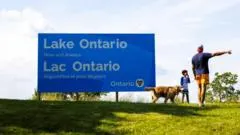
Ontario's premier, Doug Ford, installed a large sign on the Canadian shore of Lake Ontario reading "Lake Ontario. Now and Always," in direct response to Donald Trump's move to rename the lake "Lake America." Trump signed an executive order to that effect, instructing the US Department of the Interior to update the official name within 30 days, and posted mocking AI-generated videos, including one of himself kicking over a "Lake Ontario" sign. Google subsequently updated its US maps to display "Lake America," while users in Canada continue to see "Lake Ontario," echoing how the firm handled Trump's earlier renaming of the Gulf of Mexico.
The dispute followed the collapse of US-Canada trade talks, after which Washington imposed 50% tariffs on $20bn (roughly C$28bn) of Canadian goods, with Canada due to introduce "dollar-for-dollar" counter-tariffs next month. Ford said Trump's renaming reflected his dislike of Canada "standing up for ourselves," a stance echoed by Prime Minister Mark Carney, who insisted the lake would be called Lake Ontario "today and forever." Lake Ontario, the smallest of the five Great Lakes and bordering both Ontario and New York state, takes its name from an indigenous word; Mexico previously rejected a similar unilateral renaming of the Gulf of Mexico on the grounds that no single country can rename shared international waters.
- Ford unveiled a "Lake Ontario. Now and Always" sign rebuffing Trump
- Trump ordered the lake renamed "Lake America" amid a tariff row
- Google now shows "Lake America" on US maps, "Lake Ontario" in Canada
New here? Start with this
Ontario's Lake Ontario is one of the five Great Lakes that sit on the border between Canada and the United States, shared by the Canadian province of Ontario and several US states. It has always been known by that name, but US President Donald Trump has been pushing to rename it "Lake America" as part of a broader pattern of renaming shared geographic features, similar to his earlier move to rename the Gulf of Mexico. Ontario Premier Doug Ford and Canadian Prime Minister Mark Carney are the main Canadian figures pushing back against the change.
The naming dispute is unfolding against a much bigger and more serious backdrop: a trade war between the US and Canada. Talks between the two countries have broken down, and the US has imposed steep new tariffs on billions of dollars' worth of Canadian goods, with Canada preparing to respond with its own tariffs. The lake's name has become a symbolic flashpoint in this wider economic and diplomatic standoff.
It matters because it illustrates how the relationship between two of the world's closest allies and trading partners has soured, with disputes spilling from trade policy into more symbolic territory. Any US renaming would only apply within the United States itself, since other countries are not obliged to follow suit, meaning the lake's official name in Canada is unlikely to change regardless of the outcome.
Both sides, in good faith
The strongest fair case each way — we don't pick a winner.
The case for
Supporters of Ontario's response argue that firmly and calmly rejecting an unwanted renaming is a legitimate defence of national identity and sovereignty, especially when the original move was widely seen as a provocation rather than a serious policy proposal. They contend that responding with a dignified, factual sign rather than an angry statement demonstrates confidence and unity without escalating rhetoric, and that failing to push back could be read as tacit acceptance of pressure tactics during an already difficult trade dispute. On this view, small symbolic acts matter because they reassure citizens that their government will not be intimidated, even amid serious economic stakes like tariffs.
The case against
Others would argue that engaging in tit-for-tat symbolism, however mild, risks trivialising a serious diplomatic and economic rupture and distracts from the substantive work of resolving tariffs and trade talks that directly affect jobs and businesses. They might point out that matching provocation with counter-provocation, even a good-humoured sign, can entrench positions on both sides and make a face-saving de-escalation harder to achieve. From this perspective, restraint and quiet diplomacy would better serve Canadian interests than a public spectacle, however justified the underlying grievance may be.
Full account
A long-running row between Washington and Ottawa over trade has spilled into the naming of a shared Great Lake, after Ontario's premier, Doug Ford, unveiled a large sign on the Canadian shoreline reaffirming that the body of water is called Lake Ontario. The gesture came days after Donald Trump signed an executive order directing US federal agencies to refer to the lake as "Lake America", the latest flashpoint in a dispute that began when trade negotiations broke down and Washington imposed 50% tariffs on roughly $20bn (about C$28bn) of Canadian goods, prompting Canada to promise matching countermeasures.
Trump's order instructs the US Department of the Interior to update the lake's designation with the federal Geographic Names Information Service within 30 days, and he declared the change effective immediately. However, a US president's authority extends only to how federal bodies refer to a landmark domestically; it does not bind Canada, other governments or international mapping conventions, and Ottawa has given the move short shrift. Trump has continued to press the point on social media, sharing AI-generated clips of himself knocking down a Lake Ontario sign and erecting one reading "Welcome to Lake America", as well as a video depicting geese with his hairstyle patrolling the shore armed with rifles.
Ford unveiled his sign at a lakeside conservation area, framing it as proof that Canadians would not be intimidated. He argued that Trump's push to rename the lake stemmed from irritation at Ontario and Canada refusing to be pushed around, and said the marker was there to remind Trump and anyone else that the lake had been called Lake Ontario long before his presidency and would remain so long after it. His comments echoed an earlier statement from Prime Minister Mark Carney, who noted that the name derives from the Wendat word Ontari'io, roughly meaning "beautiful, big lake", and predates both Canadian confederation and American independence by centuries; Carney also took a pointed swipe at the pace of change in US policy more broadly, from trade to place names.
The dispute revives a similar episode from earlier in Trump's presidency, when he ordered the Gulf of Mexico be referred to as the "Gulf of America" for US purposes, a change Mexico rejected and which triggered a separate legal wrangle with Google over how the water was labelled on its maps — a compromise under which the name shown depends on the user's location. Most of the Great Lakes, including Ontario, Huron, Michigan and Erie, carry names rooted in Indigenous languages, while Lake Superior's name comes from an anglicised French term. As things stand, the practical effect of Trump's order is largely symbolic within the United States, while Lake Ontario continues to be recognised under its historic name everywhere else, including by the Canadian province it borders alongside New York state.
Where outlets differ
One account (styled closer to a wire/broadcast report) gives more background context — the tariff figures behind the trade dispute, the 30-day deadline for updating the US Geographic Names Information Service, the Indigenous origins of the Great Lakes' names, and the earlier Gulf of Mexico/Google Maps precedent.
The other account (drawing on the Globe and Mail) provides more scene-setting detail, specifying the sign was unveiled at the 50 Point Conservation Area in Hamilton, and includes a fuller Carney quote citing the Wendat-language origin of 'Ontario' and its age relative to Confederation and US independence.
Framing differs slightly: one report leans on Ford's 'never back down from a bully' language emphasising defiance, while the other foregrounds the mechanics and limits of Trump's executive order.
More coverage
- Daily Mail — Trump taunts Canada over Lake Ontario name change after region's premier unveiled defiant sign rejecting 'Lake America'
- NPR — Canada claps back at Trump's efforts to rename Lake Ontario as 'Lake America'
- The Hill — Ford says Trump renaming Lake Ontario is 'something out of Saturday Night Live'
Read the full article at the source →
Originally published by BBC World as “Canada installs large Lake Ontario sign in latest jab at US”.