Cyborg cockroaches with tiny syringes designed to join search and rescue teams in major disasters
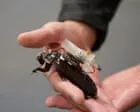
Australian researchers are testing giant burrowing cockroaches equipped with cameras and tiny medical injectors as possible first responders in earthquakes and other disasters. The cyborg insects could enter unstable, narrow spaces that rescuers cannot safely reach, locate trapped people and deliver emergency assistance under human control.
The University of Queensland and UNSW team fitted the cockroaches with lightweight electronics and remotely activated injection systems. In trials, close-range injections succeeded 95% of the time, while the full navigation-and-injection task succeeded in 72% of trials; researchers hope specialised insect teams could be deployed within five to 10 years.
- Cyborg cockroaches may assist people trapped in disaster rubble.
- Trials achieved 95% close-range injection success.
- Researchers envisage rescue insect teams within a decade.
New here? Start with this
Search and rescue teams often face unstable rubble, narrow gaps and other hazards after earthquakes and major disasters. Small robotic devices can be difficult to move through such spaces, prompting researchers to explore whether insects could carry cameras and other equipment into them.
Researchers at the University of Queensland and UNSW are testing giant burrowing cockroaches fitted with lightweight electronics and remotely controlled injectors. The idea is for human operators to guide the insects to trapped people and deliver emergency assistance, while rescuers remain in control.
The trials assess how reliably the insects can be steered and the injectors operated. If the approach proves practical, it could give rescue teams another way to reach people in places that are difficult or unsafe for humans to enter.
Both sides, in good faith
The strongest fair case each way — we don't pick a winner.
The case for
These cyborg cockroaches could revolutionise disaster rescue by reaching trapped survivors in spaces where humans cannot safely venture, potentially saving lives otherwise lost. Cockroaches are naturally suited to the task, and the demonstrated 95% injection success rate shows the concept is technically viable. With deployment possible within five to ten years, this represents a practical application of bioengineered technology that could reduce risks to human rescuers whilst deploying a genuine force multiplier in catastrophic situations.
The case against
Modifying living creatures with invasive electronics and deploying them into dangerous environments raises serious animal welfare concerns that deserve careful consideration. Cockroaches have not evolved for such purposes, and the implant procedures and conditions they experience constitute harm that warrants questioning whether the benefit justifies the cost. Alternative technologies such as autonomous drones and remote robots are rapidly improving and could achieve similar rescue capabilities without compromising animal welfare, suggesting this approach may be ethically unnecessary.