World news and discussion on TalkFuse.
Death toll from Bangkok bar fire rises to 30 as police probe safety lapses
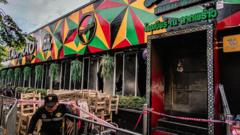
Thai police are investigating whether negligence contributed to a fire that swept through a Bangkok bar late on Sunday, killing at least 30 people and injuring dozens more. Survivors and safety experts say locked doors, obstructed exits and a lack of illuminated emergency signage prevented patrons from escaping, while flammable decorative materials on the stage and ceiling allowed the blaze to spread rapidly. The incident has raised serious questions about safety enforcement at entertainment venues in the Thai capital, particularly given that the bar was not legally required to use fire-retardant materials.
Investigators believe the fire, which broke out near the stage during a live performance, was likely triggered by a short circuit in an air conditioner that knocked out power throughout the venue. Of the 30 dead, 27 had been identified by Tuesday morning, and more than 70 people were injured, 24 of them critically; many victims were found in restrooms at the back of the bar, where they had apparently fled but found themselves trapped. Experts noted that flammable stage decorations, including plastic flowers and foam ceiling panels, generated toxic smoke that may have killed some victims before flames reached them. The venue, Rong Beer Na Lat Phrao, was registered as a "restaurant with live music" rather than an "entertainment venue," exempting it from fire-retardant material rules, prompting Bangkok's Metropolitan Administration to review such regulations.
In short
- Bangkok bar fire death toll rises to 30, dozens injured
- Locked doors and blocked exits likely trapped fleeing patrons
- Flammable decorations and lax venue classification under scrutiny
Steelman: both sides, in good faith
The strongest fair case each way — we don't pick a winner.
The case for
The tragedy unmasks a critical regulatory failure. The venue's classification as a 'restaurant with live music' allowed it to sidestep fire-retardant material requirements whilst hosting crowds comparable to entertainment venues. Combined with locked exits, obstructed passages and absent emergency signage, the loophole demonstrates that fragmented regulations across different venue categories create avoidable risks. Comprehensive safety standards should apply uniformly to all spaces serving large numbers of patrons, regardless of licensing classification, with mandatory fire-retardant materials, unobstructed exits and illuminated emergency signage across all establishments.
The case against
Whilst the tragedy demands action, the focus should be on enforcing existing regulations rather than expanding them further. Safety codes already prohibit locked emergency exits and obstructed passageways. The real issue is compliance—inspections must be rigorous and venue operators held accountable for following rules already in place. Thailand's regulatory framework, if properly enforced, would have prevented this incident. Rather than creating additional layers of regulation that risk similar non-compliance, authorities should strengthen inspection capacity and enforcement mechanisms to ensure current standards are consistently met.
Explained simply
Bangkok’s bars and restaurants can host live music, but their legal classification affects which safety rules apply. A venue registered as a restaurant may face different requirements from one classed as an entertainment venue, including rules on fire-resistant materials.
In a crowded building, locked or obstructed exits and unclear emergency signs can make it difficult for people to escape. Flammable decorations can also help a fire spread and produce dangerous smoke.
Thai police are examining the fire’s cause and whether safety failures contributed to the deaths and injuries. The case has prompted Bangkok officials to review how venue classifications affect fire-safety requirements.