LISA could offer NASA a practical partnership with Europe
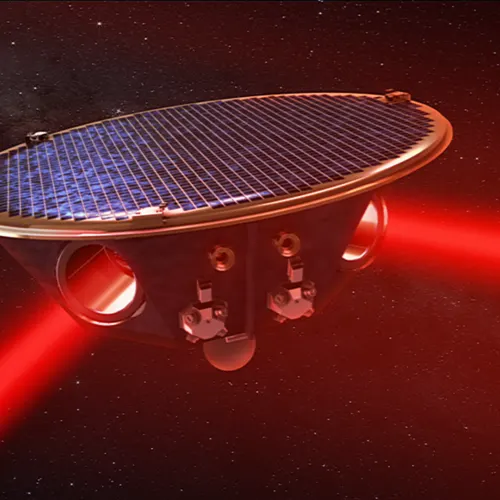
NASA is seeking international space partnerships that offer practical, timely contributions to US priorities, as it shifts resources towards a Moon Base and competition with China. A proposed joint science mission with Europe, LISA, could fit that approach by delivering valuable research while NASA contributes specific expertise and technology.
LISA is planned as the first space-based observatory for gravitational waves, led by the European Space Agency with significant US contributions. Three spacecraft would fly in a triangle in orbit around the Sun, about 2.5 million kilometres apart, using lasers to track tiny changes in distance caused by gravitational waves; launch is planned for around 2035. The article contrasts this science partnership with cancelled NASA-led projects such as Lunar Gateway and Mars Sample Return, and notes Japan and Italy’s planned contributions to the Moon Base.
- NASA wants international partners to make timely, meaningful contributions.
- Europe-led LISA could be a strong US-European science partnership.
- The mission’s three spacecraft would be 2.5 million kilometres apart.
New here? Start with this
NASA is adjusting its international space partnerships to focus on practical projects aligned with its priorities, particularly building a Moon Base and competing with China in space. As part of this shift, the space agency is considering whether a European-led project to detect gravitational waves could work as a joint mission, with NASA contributing expertise and technology.
LISA is a planned observatory that would operate in space to detect gravitational waves, which are ripples in space caused by catastrophic cosmic events like colliding black holes. The project, led by the European Space Agency, would launch around 2035 and involve three spacecraft flying in a vast triangle formation about 2.5 million kilometres apart, using lasers to measure infinitesimal changes in the distance between them.
The proposed partnership represents NASA's interest in science missions that deliver results without diverting resources from its core priorities. This contrasts with some earlier NASA-led projects that have been shelved or scaled back, though other countries including Japan and Italy are contributing to the Moon Base initiative.
Both sides, in good faith
The strongest fair case each way — we don't pick a winner.
The case for
Advocates argue that in an era of constrained budgets and intensifying space competition, NASA must make disciplined choices about which partnerships to pursue. Selecting initiatives like LISA—where Europe leads with genuine scientific credentials and NASA contributes specific expertise—allows the agency to serve national interests in lunar development and technological competitiveness whilst maintaining meaningful international collaboration. This approach is pragmatic rather than cynical: it acknowledges that partnerships thrive when contributions are clear and mutual benefit is demonstrable, avoiding the overcommitment that led to previous project cancellations.
The case against
Critics contend that subordinating international space cooperation to geopolitical competition betrays space exploration's foundational purpose as a realm of shared human discovery. They argue that gravitational wave science has value independent of strategic positioning with China, and that treating partnerships instrumentally—judged against national interest benchmarks—corrodes the genuine collaboration that has historically made space exploration transcend national boundaries. This shift risks signalling that the US partners with others for tactical advantage rather than common purpose, potentially alienating allies and undermining the moral foundation that justified public investment in space exploration as a broadly human endeavour.
Read the full article at the source →
Originally published by Ars Technica as “If you’re looking, here’s a “good deal” for NASA and the European Space Agency”.