Is Russia proving better at protecting friends than fighting enemies in West Africa?
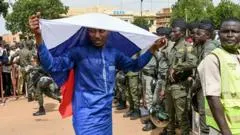
When mutinous soldiers seized a strategic military base in Niger's capital, Niamey, last Saturday, the ruling junta relied on Russia's Africa Corps to help loyalist forces retake control after a night of fighting. The episode is seen as the clearest evidence yet that Russia's military presence in Niger, Mali and Burkina Faso extends beyond fighting jihadist insurgents to actively propping up the military governments themselves, offering these regimes a political lifeline even as it fails to resolve the underlying security crisis.
Africa Corps, which unlike its predecessor Wagner Group operates directly under Russia's defence ministry, is thought to have 200 to 300 personnel in Niger and also helped repel a jihadist attack at the same airport in January. Analysts note the insurgency that partly justified the 2023 coup remains unresolved three years on, with al-Qaeda- and Islamic State-linked militants still attacking regions such as Tillabéri and Dosso, and say the latest mutiny reflects deep grievances among Nigerien troops who feel poorly equipped and supported by the junta.
In short
- Russia's Africa Corps helped Niger's junta crush a military mutiny
- Moscow now seen as protecting regimes, not just fighting jihadists
- Underlying insurgency remains unresolved three years after 2023 coup
Steelman: both sides, in good faith
The strongest fair case each way — we don't pick a winner.
The case for
Supporters could argue that helping Niger’s government regain control after a mutiny, and repelling an earlier jihadist attack, shows Russia can provide practical security support when local forces are under pressure. In their view, stabilising the state and protecting it from both insurgents and armed challengers may be a necessary step towards addressing the wider crisis.
The case against
Critics could argue that Russia’s most visible success is protecting the junta, while the insurgency that helped justify the coup remains unresolved and Nigerien troops’ grievances persist. They may see outside military support as prolonging the rulers’ hold on power without fixing the weak equipment, support and security conditions that fuel instability.
Explained simply
Russia has become one of the main outside military partners for the juntas that took power in coups in Niger, Mali and Burkina Faso between 2020 and 2023, after each country cut ties with former colonial power France. Its involvement now runs through Africa Corps, a unit controlled directly by the Russian defence ministry, which took over from the more freelance Wagner Group after Wagner's leader died in 2023.
Niger's government has been run by a military junta since a 2023 coup, which the soldiers involved justified partly by pointing to the country's long-running fight against Islamist insurgents linked to al-Qaeda and Islamic State. Russian personnel were brought in partly to help with that fight, but they have increasingly also been used to protect the junta itself from threats closer to home, including from within its own armed forces.
This matters because it points to a shift in what Russia's presence in the region is actually achieving. Rather than defeating the jihadist insurgencies that have destabilised these countries for years, Russian forces appear more focused on keeping the current military rulers in power, raising questions about the trade-offs these governments have made in seeking Moscow's support.