Politics news and discussion on TalkFuse.
Netanyahu offers Eisenkot first turn as prime minister in unity bid
Developing story first seen 3 hours ago
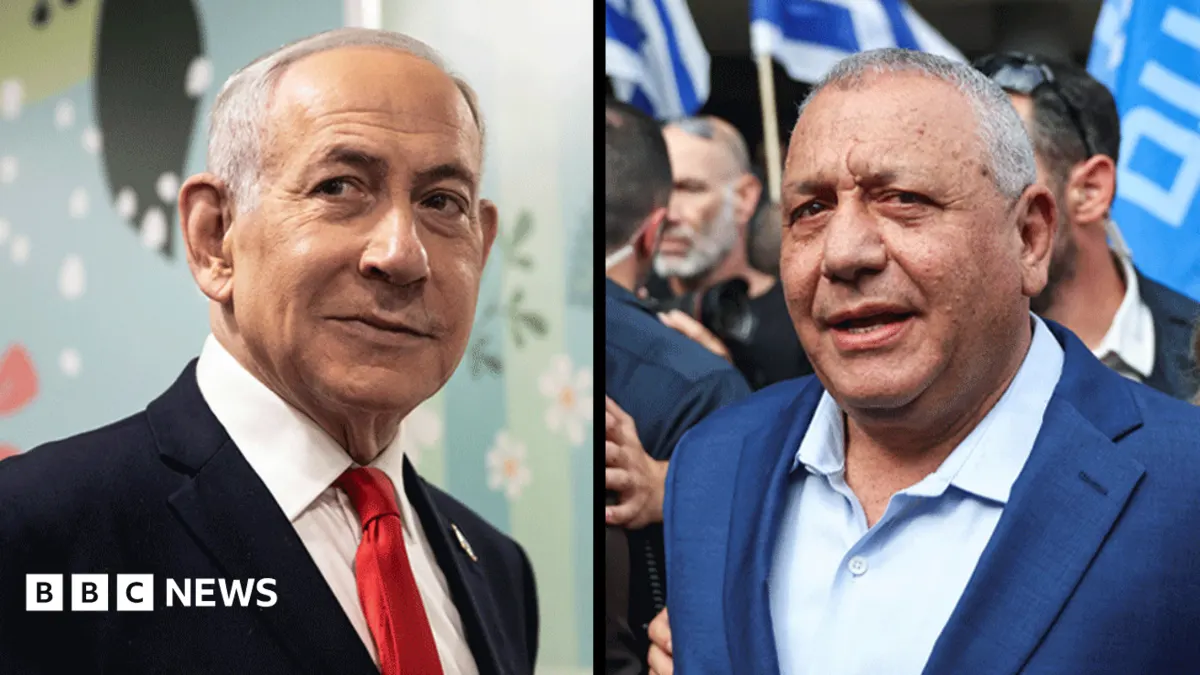
Israel's caretaker Prime Minister Benjamin Netanyahu has offered to let opposition leader Gadi Eisenkot serve first as prime minister in a rotating national unity government, and the two are due to meet on Sunday. Eisenkot welcomed the offer as a step toward "genuine and accelerated negotiations", but said Likud had not yet responded to his detailed proposal sent the previous Sunday. Eisenkot must form a government by 6 December, and President Isaac Herzog has given him 28 days to do so.
Neither bloc has a majority in the 120-seat Knesset. Eisenkot's Yashar party and three other Jewish opposition parties won 48 seats in October, while Netanyahu's bloc won 53. Two Arab-led alliances won 19 seats, but most Jewish parties had ruled out working with them, although Raam leader Mansour Abbas has said his party recognised Hamas as a "terror group", which could open a route into a coalition. Eisenkot has already agreed deals with Yisrael Beiteinu and The Democrats, and former prime minister Naftali Bennett has backed a unity government involving Likud.
- Sources
- 2
- Outlets
- 2
- Left · Centre · Right
- 1 · 1 · 0
In short
- Netanyahu offers Eisenkot the first turn as prime minister
- Eisenkot says Likud has not yet answered his detailed proposal
- Neither bloc has a majority, and the government deadline is 6 December
How this story developed
- 30 minutes ago Benjamin Netanyahu has offered to let opposition leader Gadi Eisenkot serve first as prime minister in a rotating unity government, ahead of their talks to break Israel’s post-election deadlock.
- 34 minutes ago Israel's caretaker Prime Minister Benjamin Netanyahu has offered to let opposition leader Gadi Eisenkot serve first as prime minister in a rotating national unity government, and the two are due to meet on Sunday.
Where outlets differ
Left-leaning outlets 1
Only here: pressure, rival, lead, government
Centre outlets 1
Only here: eisenkot, turn, prime, minister
Every side used: netanyahu, offers, unity
Headline columns compared word for word; nothing in them is AI-written.
Steelman: both sides, in good faith
The strongest fair case each way — we don't pick a winner.
The case for
Supporters of a rotating unity government argue that a fragmented Knesset in which neither bloc can reach a majority makes a broad coalition the most practical route out of deadlock, and that stability in security, diplomacy and budgeting should take priority over partisan victory. They point out that rotation gives Eisenkot real executive authority and a defined timetable, offering a compromise that recognises the national interest in ending weeks of stalled talks. For them, a deal of this kind is a responsible exercise of leadership rather than a surrender of principle.
The case against
Critics contend that sharing the premiership with a leader whose legal and political record has divided opinion risks legitimising him and blurring accountability for voters who backed change at the ballot box. They argue that a unity arrangement built around the distribution of office, rather than around agreed policy, could dilute the opposition's electoral mandate and leave its core commitments unfulfilled. From this perspective, the timing and terms of the offer deserve scrutiny, and a principled opposition may be better served by holding its position than by entering an arrangement that favours the status quo.
Explained simply
Israel elects its 120-member parliament, the Knesset, by proportional representation, so no party usually wins a majority on its own. To form a government, a prime minister must assemble a coalition of at least 61 seats. The most recent election left the main blocs short of that number, so the country has been without a settled government while parties negotiate.
The central figure is Benjamin Netanyahu, who has led Israel for much of the past two decades and heads the bloc that won the most seats. Gadi Eisenkot, a former military chief of staff, leads the main opposition bloc, and Naftali Bennett, a former prime minister, has called for a broad unity government. Mansour Abbas leads Raam, an Arab Islamist party whose possible role is politically sensitive, because most Jewish parties have refused to work with Arab-led groups.
The outcome will determine who governs Israel and which policies a new administration pursues, at a time of ongoing domestic and regional pressures. The long deadlock has prolonged uncertainty for voters and institutions alike. Any coalition that includes Arab parties would also mark a notable shift in Israeli politics.
Coverage · 2 sources
Bias meters
From 2 rated sources.
Elections Government Middle East Politics World
Read the full article at the source →
Originally published by BBC World as “Israeli leadership rivals to hold critical talks to break election deadlock”.