Jeers, walkouts, stage invasions: will Catarina and the Beauty of Killing Fascists trigger British audiences too?
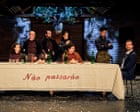
Tiago Rodrigues’s play *Catarina and the Beauty of Killing Fascists* will arrive at London’s National Theatre after provoking unusually forceful audience reactions across Europe and Canada. Its depiction of fascism and anti-fascist violence has led to jeering, walkouts, singing, protests and attempted stage invasions, raising questions about how theatre confronts political extremism and the limits of tolerance.
The drama centres on a Portuguese family that annually kills a kidnapped fascist in memory of Catarina Eufémia, a farm worker murdered by Salazar’s police in 1954. In its final half-hour, however, the captive is freed and delivers an uninterrupted far-right victory speech; since the 2020 premiere, Rodrigues says only a handful of roughly 200 performances have heard it in silence. Responses have ranged from anti-fascist songs in Portugal and Italy to far-right protests in Rome, while the play also challenges whether opposition to intolerance can itself become intolerant.
- A provocative anti-fascist play is coming to London.
- Its final far-right speech often prompts audience intervention.
- The drama questions violence, tolerance and political resistance.
New here? Start with this
Portugal was ruled by António de Oliveira Salazar’s authoritarian Estado Novo regime from the 1930s until 1974. The government restricted political opposition, censored the press and used police forces against critics. Catarina Eufémia was a farm worker whose killing by police during a wage protest in 1954 made her a symbol for opponents of the dictatorship.
Fascism is a form of far-right politics associated with authoritarian rule, intense nationalism and the suppression of opponents. The term is often used more broadly in political debate, which can make arguments over who should be labelled fascist especially charged. Anti-fascism refers to movements opposing fascism and related far-right ideas.
The play uses a fictional family’s ritual of killing a political enemy to examine whether resisting intolerance can justify violence or silencing. Its structure also gives a far-right character a lengthy platform, placing audiences in the position of deciding whether to listen, protest or leave.
Both sides, in good faith
The strongest fair case each way — we don't pick a winner.
The case for
Supporters argue that the play is a necessary test of democratic resilience: it forces audiences to face both the brutality of fascism and the uncomfortable possibility that righteous opposition can abandon its own principles. Giving the captive an extended far-right speech is not endorsement but a deliberate challenge to engage with dangerous ideas rather than simply suppress them. They may see strong audience reactions as evidence that theatre remains a valuable civic space for confronting extremism, historical memory and the ethics of political violence.
The case against
Critics argue that presenting a long, uninterrupted far-right victory speech can give hateful politics an authority and emotional force that exceeds the play’s critical framing, particularly for audience members directly affected by fascist violence. They may also contend that a drama built around ritual killing risks treating political murder as intellectually provocative or aesthetically compelling rather than clearly examining its human cost. From this perspective, disruption or withdrawal can be a principled refusal to normalise rhetoric that threatens vulnerable groups, rather than an unwillingness to tolerate debate.