Technology news and discussion on TalkFuse.
NASA’s Voyager 1 space probe is now one light-day away from Earth
Developing story first seen 2 hours ago
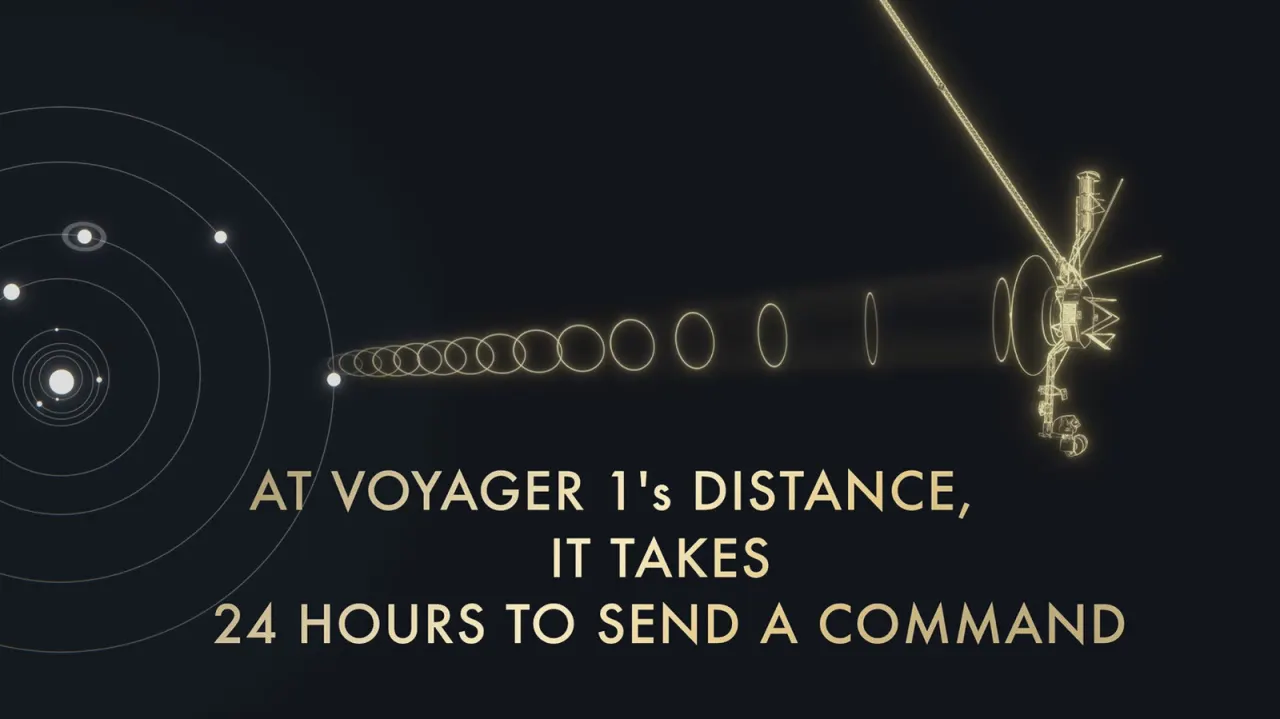
NASA estimates Voyager 1 has reached a distance of one light-day from Earth, a milestone that makes it the first spacecraft to be so far away. The distance matters because radio signals travel at the speed of light: sending a command now takes about 24 hours, with a further 24 hours for a reply.
The probe is believed to be about 16 billion miles from Earth after travelling for 49 years, two months and 11 days. NASA expects it reached the milestone at 5:16:07 am Eastern time on 18 November, but can confirm the timing only after receiving its next message. Launched in 1977, Voyager 1 entered interstellar space in 2012 and continues to operate despite technical problems and dwindling power; it is heading towards Gliese 445, which it is expected to pass within 1.7 light-years of in about 40,000 years.
- Sources
- 4
- Outlets
- 4
- Left · Centre · Right
- 1 · 0 · 0
In short
- Voyager 1 is believed to be one light-day from Earth.
- Radio signals now take about a day each way.
- The probe is still travelling through interstellar space.
How this story developed
- 56 minutes ago NASA now estimates that Voyager 1 has reached one light-day from Earth, a milestone that means radio commands take about 24 hours to reach the probe and a reply takes another 24 hours. Its exact arrival time cannot be confirmed until NASA receives the next message, expected tomorrow.
- 1 hour ago NASA estimates Voyager 1 has reached a distance of one light-day from Earth, a milestone that makes it the first spacecraft to be so far away.
- 1 hour ago NASA’s Voyager 1 is believed to have reached a distance of one light-day from Earth, an unprecedented milestone for a human-made probe.
- Wired Voyager 1 Beat the Odds and Is Still Working a Light-Day Away From Earth
- The Guardian After 49 years, Nasa’s Voyager 1 is one light-day away from us. Can we save this ‘pale blue dot’? |
- Engadget NASA’s Voyager 1 space probe is now one light-day away from Earth
- Ars Technica Voyager 1 at one light-day: Historian revisits Golden Record's forgotten details
Full account
NASA’s Voyager 1 is estimated to have reached a distance of one light-day from Earth on 18 November 2026, becoming the first human-made object to cross that threshold. A light-day is the distance light travels in 24 hours. At roughly 16 billion miles from Earth, Voyager 1’s radio signals now take about a day to reach the spacecraft and another day to return. NASA’s predicted crossing time is 5:16:07 a.m. Eastern time; confirmation depends on receiving a signal from the probe, so the precise timing may not be known until the following day.
Launched in September 1977, Voyager 1 was sent to study the outer planets, including Jupiter and Saturn. It later continued beyond the planets and entered interstellar space in 2012, crossing the heliopause, the boundary where the Sun’s influence gives way to the space between star systems. Its twin, Voyager 2, also travelled into interstellar space, but Voyager 1 is now farther from Earth. The mission has lasted far beyond its original planetary tour, and engineers have had to manage technical faults and conserve power as the plutonium-powered generator weakens.
The probe’s distance presents a practical challenge for its operators: commands and replies each take about a day to travel, slowing troubleshooting and routine work. Yet Voyager 1 continues to send scientific measurements from a region that is difficult to study directly. Those observations help researchers investigate how the Sun’s influence extends into interstellar space. The spacecraft is also moving through material that the Solar System itself is expected to encounter in the coming years, offering a way to study that environment in advance.
Voyager 1 carries a Golden Record, a gold-plated copper disc intended as a record of life and culture on Earth in case another civilisation encounters it. Its contents include images, spoken greetings, music and natural sounds, alongside instructions and a map using pulsars to indicate the Solar System’s position. The milestone has also renewed attention to the record’s design and history: one report focuses on research into overlooked operating instructions and surviving duplicates. Voyager 1’s journey continues, although its eventual end of mission may come as its power declines; it is expected to pass relatively near the star Gliese 445 in about 40,000 years.
The reports differ in emphasis and precision. One gives NASA’s estimated crossing time and stresses that the event cannot be confirmed until a signal arrives; another presents the milestone as a technological achievement and highlights the probe’s scientific value and long communication delay. A third takes a reflective approach, linking the spacecraft’s journey to the Golden Record and the “Pale Blue Dot” image. The fourth centres on the record’s hardware and historical research, while also treating 18 November as the date Voyager 1 reached one light-day. The figures are broadly consistent, though one report gives 16.1 billion miles and another describes the distance as about 16 billion miles.
Explained simply
Voyager 1 is a NASA spacecraft launched in 1977 to study the outer planets and the space beyond them. It passed the edge of the Sun’s influence and entered interstellar space in 2012, becoming the first spacecraft to do so.
The probe is still sending information to Earth, although its power supply is weakening and some instruments have had technical problems. Its signals travel at the speed of light, so as Voyager gets farther away, communication takes longer. This makes it harder for engineers to operate the spacecraft and learn about the space it is travelling through.
Coverage · 4 sources
- EngadgetNASA’s Voyager 1 space probe is now one light-day away from Earth
- WiredVoyager 1 Beat the Odds and Is Still Working a Light-Day Away From Earth
- The GuardianLeftAfter 49 years, Nasa’s Voyager 1 is one light-day away from us. Can we save this ‘pale blue dot’? |
- Ars TechnicaVoyager 1 at one light-day: Historian revisits Golden Record's forgotten details