Second complete map of a fruit fly brain completed
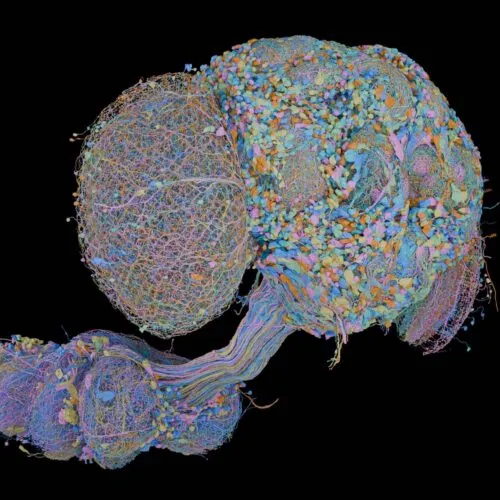
Researchers at the Howard Hughes Medical Institute's Janelia Research Campus and Google have completed a full "connectome" of a male fruit fly's brain, mapping every neuron and the connections between them. This follows the completion of a female Drosophila connectome earlier in 2026, giving scientists two complete brain maps to compare and a powerful new tool for studying how neural circuits produce behaviour. The achievement is also significant as a proof of concept for techniques that could eventually be applied to more complex nervous systems, potentially including those of vertebrates.
A connectome catalogues every neuron's location and every synaptic connection it forms, since this wiring dictates how sensory information is processed and turned into outputs such as memories or movement. Although the fruit fly's nervous system contains only around 150,000 neurons, the brain's neurons form over 300 million synaptic connections, a scale that required advanced imaging and machine-vision algorithms rather than the manual tracing methods used decades ago on simpler organisms such as the roundworm C. elegans. The project relied on a close collaboration between biologists, who prepared and imaged the tiny, opaque brain, and computer scientists, who developed the tools needed to reconstruct and interpret the resulting data.
In short
- Scientists mapped every neuron in a male fruit fly's brain
- It joins an earlier female Drosophila connectome completed this year
- Brain has just 150,000 neurons but 300 million+ synapses
Explained simply
A connectome is a map of the brain’s nerve cells and the tiny junctions, called synapses, where they pass signals to one another. These connections help shape how an animal takes in information and produces responses such as movement or memory.
Fruit flies have about 150,000 brain cells, but hundreds of millions of connections between them. Mapping them required detailed imaging and computer tools to trace the wiring, alongside work by biologists to prepare the brain.
A complete map gives researchers a way to study how brain circuits relate to behaviour. Maps of both male and female fruit fly brains also let scientists compare their wiring, while the techniques may help guide future efforts to map larger, more complex brains.