The world’s biggest solar telescope caught vortexes on the Sun’s surface
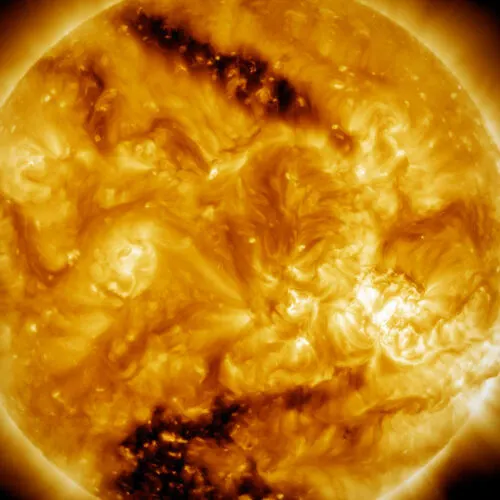
Scientists using the Daniel K. Inouye Solar Telescope have directly observed tiny vortex-like structures on the Sun’s surface, providing evidence of the Kelvin–Helmholtz instability in solar plasma. The finding matters because these previously unseen motions could alter understanding of how heat, matter and magnetic energy are transported through the Sun’s atmosphere.
The observations were made during a three-minute session on 14 April 2025, when the 4-metre Hawaiian telescope recorded an active solar region at 416 nanometres. Its camera captured 740 frames per second, with 2,000 frames combined to produce images every two seconds at roughly 19-kilometre resolution; researchers identified 47 vortex-bearing interfaces between magnetic-field bundles and surrounding convection cells.
In short
- Largest solar telescope reveals long-suspected plasma vortexes.
- Observations reached about 19-kilometre resolution.
- Vortexes may affect energy transport in the Sun.
Explained simply
The Sun’s visible surface is a layer of hot, electrically charged gas, or plasma, where energy rises from deeper inside. Its surface is constantly moving: hot material rises and cooler material sinks, while magnetic fields gather the plasma into bundles.
The Daniel K. Inouye Solar Telescope is a large telescope in Hawaii built to observe the Sun in fine detail. Scientists study how the Sun’s plasma and magnetic fields move because those motions help explain how energy and matter pass through the Sun’s atmosphere and shape activity there.