US strikes Iranian launchers on Larak Island in first known attack in weeks
Developed over time first seen 2 months ago
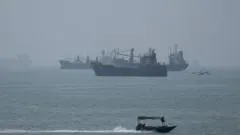
US forces struck two Iranian rocket launchers on Larak Island in the Strait of Hormuz, the first known American attack on Iran since Donald Trump paused his renewed military campaign in late July. US Central Command said the "limited, precise action" followed observations that Iran was preparing to fire rockets and lay sea mines in the strait, a vital global shipping route. Iran's Revolutionary Guard said the strike killed two people and injured two others, and retaliated by firing missiles at US bases in Jordan, which said it intercepted eight of them; Iran also claimed a drone strike on a UAE air base, which the UAE denied, though it confirmed downing a drone.
Larak Island sits off the port of Bandar Abbas, through which about 20% of the world's oil and gas passed before the wider conflict began in February; the strait has since been effectively closed, and Iran has reportedly been charging vessels $2m (£1.5m) to pass the island for inspection. Centcom separately dismissed an Iranian claim that a supertanker had hit a mine and caught fire as "disinformation", while Iranian President Masoud Pezeshkian said Tehran was "not seeking war" but would deliver a "decisive response", and Trump posted apparent AI-generated videos on Truth Social depicting Iranian oil infrastructure exploding.
- US hits Iranian rocket launchers on Larak Island, first strike since July
- Iran retaliates with missiles on US bases in Jordan
- UAE denies Iranian claim of drone strike on its air base
New here? Start with this
Iran's rocket launcher setup on Larak Island is part of a wider conflict between the United States and Israel on one side and Iran on the other, which began with joint US-Israeli strikes at the end of February. The Strait of Hormuz sits at the centre of the dispute because it is one of the world's busiest shipping lanes, carrying roughly a fifth of global oil and gas before the fighting started, and Iran controls territory along it, including Larak Island near the port of Bandar Abbas.
The key players are US Central Command, which carries out American military action in the region, and Iran's Revolutionary Guard (IRGC), an elite military and security force that answers directly to Iran's leadership and has been central to Tehran's response to the conflict. President Donald Trump had paused a renewed US campaign against Iran in late July, and Washington has also been applying economic pressure through sanctions.
This matters because any disruption to the Strait of Hormuz, whether through mines, rocket attacks or blockading measures, has the potential to affect global energy supplies and shipping costs well beyond the region. It also shows that despite pauses in fighting and diplomatic claims that threats such as mines have been cleared, the risk of renewed military action between the US and Iran remains active.
Both sides, in good faith
The strongest fair case each way — we don't pick a winner.
The case for
Supporters of the strike argue that a state has both the right and the responsibility to act pre-emptively when it has credible intelligence that an adversary is arming rockets with sea mines aimed at one of the world's most vital shipping arteries. From this view, allowing IRGC forces to complete such preparations unchallenged would risk a catastrophic blockage of the Strait of Hormuz, endangering global energy supplies and the safety of civilian shipping crews. Given Iran's continued disregard for previous warnings and its practice of levying transit charges on vessels near Larak Island, proponents contend that a narrowly targeted strike on the launchers themselves, rather than broader escalation, is a proportionate and necessary act of deterrence to protect international commerce and demonstrate that threats to freedom of navigation carry real consequences.
The case against
Critics argue that resuming strikes after a month-long pause risks reigniting a war that has already run six months and inflicted significant human and economic cost, undermining any prospect of de-escalation or negotiated settlement. They point out that Washington's own claim last week that all mines had been cleared sits uneasily with a strike now justified by an imminent mine-laying threat, raising legitimate questions about the intelligence basis and timing of the action, particularly so soon after fresh sanctions were imposed. From this perspective, unilateral military action against a sovereign state's forces on its own territory, however narrowly framed, invites retaliation, further entrenches cycles of violence, and places the burden of proof on assurances of precision and necessity that the public has limited means to verify independently.