Saudi Arabia set to gain US-backed civilian nuclear programme
Developed over time first seen 2 months ago
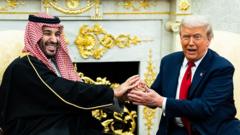
The United States and Saudi Arabia have signed a landmark deal allowing the kingdom to develop a civilian nuclear power programme, marking a significant shift in Washington's traditional non-proliferation approach and giving American firms substantial access to a decades-long, multi-billion-dollar partnership. Notably, the agreement was not made conditional on Saudi Arabia normalising diplomatic relations with Israel, despite this being a long-standing aspiration of successive US administrations. The deal has drawn concern from nuclear experts and former Israeli officials, who warn it could eventually give Saudi Arabia a pathway to nuclear weapons capability.
The pact comprises a "peaceful nuclear co-operation agreement" and a "bilateral safeguards agreement", signed by US Energy Secretary Chris Wright, with President Trump having already approved the deal according to the Wall Street Journal. While specifics were not disclosed, earlier reports indicated Saudi Arabia may eventually be permitted to enrich uranium domestically at a US-built facility following a joint study, rather than relying on imported fuel — a notably looser arrangement than the 2009 US-UAE nuclear agreement, under which the UAE does not enrich its own fuel. If the US objects to enrichment after the study, Saudi Arabia would be barred from doing so independently or with another partner for ten years; the agreement now goes to Congress, where opposition is expected from lawmakers on both sides.
- US and Saudi Arabia sign civilian nuclear co-operation agreement
- Deal not tied to Saudi recognition of Israel
- Saudi Arabia may eventually enrich uranium domestically, unlike UAE deal
New here? Start with this
Saudi Arabia's civilian nuclear ambitions have been discussed with Washington for years, but talks have repeatedly stalled over concerns about proliferation, since the technology needed for peaceful nuclear power can, in some circumstances, also be adapted towards weapons production. The kingdom has long said it wants nuclear energy to diversify away from oil, while some officials have previously suggested Saudi Arabia would seek weapons capability if regional rival Iran obtained one. Any deal of this kind requires sign-off from the US Congress, which vets nuclear cooperation agreements to ensure they meet non-proliferation standards.
Previous US nuclear agreements, such as the one with the United Arab Emirates in 2009, required the partner country to forgo domestic uranium enrichment and reprocessing, relying instead on imported fuel, as a safeguard against the technology being diverted to weapons use. Enrichment is significant because uranium refined to low levels can fuel a power station, while uranium enriched much further can form the core of a nuclear weapon, which is why arrangements allowing a country to enrich its own fuel draw closer scrutiny.
The prospect of closer US-Saudi nuclear cooperation had previously been linked by some in Washington to a broader push for Saudi Arabia to establish diplomatic relations with Israel, part of a wider set of regional normalisation efforts. Israel has historically opposed any expansion of nuclear capability among its neighbours, given long-standing concerns about weapons proliferation in the Middle East, making Riyadh's nuclear plans a matter of interest well beyond the two countries directly involved.
Both sides, in good faith
The strongest fair case each way — we don't pick a winner.
The case for
Supporters argue Saudi Arabia has a legitimate right to develop civilian nuclear energy to diversify its economy away from oil, and that keeping US firms at the centre of the project ensures far tighter oversight, safety standards and strategic influence than if Riyadh turned to Russia or China instead. They contend the deal secures lucrative contracts for American companies, deepens a crucial security partnership in a volatile region, and that the enrichment safeguards, including the joint study and the ten-year bar on unilateral pursuit if Washington objects, provide meaningful checks rather than a blank cheque. Decoupling the agreement from Israeli normalisation is seen as pragmatic, allowing progress on one strategic front without holding it hostage to a separate and more difficult negotiation.
The case against
Critics, including nuclear non-proliferation experts and former Israeli officials, worry that permitting domestic uranium enrichment sets a dangerous precedent that departs from the stricter 2009 US-UAE model, potentially opening a pathway towards weapons-capable technology in a historically volatile region. They argue that removing the Israeli normalisation condition strips away important leverage the US previously held, and that a 30-year commitment worth tens of billions of dollars risks entrenching a relationship with limited ability to reverse course if Saudi intentions or the regional balance shift. Bipartisan unease in Congress reflects a broader concern that commercial and strategic incentives may be outweighing long-standing non-proliferation principles that have guided US nuclear cooperation for decades.
More coverage
Read the full article at the source →
Originally published by BBC World as “US to announce deal allowing Saudi Arabia a nuclear programme”.