Victorian plans for 90-storey high Great Pyramid of London that could hold 5million dead are remembered as burial space runs out in the capital
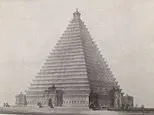
London faces a growing shortage of burial space, with 17 local authorities expected to have no capacity by 2040 and three boroughs already full. The situation has revived interest in an unbuilt Victorian proposal for a vast cemetery pyramid, illustrating the scale of the capital’s long-term challenge in accommodating its dead.
Architect Thomas Wilson proposed a 94-storey pyramid on Primrose Hill in the 1820s, designed to hold five million people in 215,219 catacomb vaults across an 18-acre site. It would have been more than four times the height of St Paul’s Cathedral, with ramps for visitors and an Egyptian-inspired granite exterior; Parliament instead favoured suburban garden cemeteries. City Hall now advises grave reuse after 100 years and deeper, multi-burial plots, while other options include development on lower-quality green-belt land.
- London burial space is expected to run out in many boroughs by 2040.
- A Victorian pyramid cemetery was designed to hold five million people.
- Councils are considering grave reuse and deeper burial plots.
New here? Start with this
Burial space is land set aside for graves and cemeteries, and London has less of it available as the city grows. Local authorities manage many cemeteries, and some boroughs have already run out of space for new graves.
In the 1820s, architect Thomas Wilson proposed a huge pyramid cemetery on Primrose Hill, with vaults for up to five million people. Parliament did not approve it, and instead backed cemeteries outside the built-up city, with gardens and paths.
Today, City Hall has advised councils to consider reusing graves after 100 years and creating deeper plots for several burials. The debate matters because London must find ways to provide burial space as well as homes and other land uses.
Both sides, in good faith
The strongest fair case each way — we don't pick a winner.
The case for
London’s burial shortage calls for long-term planning, and the projected loss of capacity gives policymakers reason to consider a wider range of options, including carefully chosen land and ways to make existing graves serve more people. A large, purpose-built site could offer substantial capacity and a planned setting for remembrance, provided its design respected local communities and the landscape.
The case against
Expanding burial provision can place lasting demands on land, landscapes and nearby communities, so proposals to use green-belt sites or build at great scale deserve close scrutiny. Grave reuse and deeper plots may offer more proportionate ways to increase capacity, while cremation and other choices can also reduce pressure; some people may object to grave reuse on grounds of faith, family wishes or the value they place on a permanent resting place.