Woman shot dead by NYPD after fatal Times Square stabbing
Developed over time first seen 2 months ago
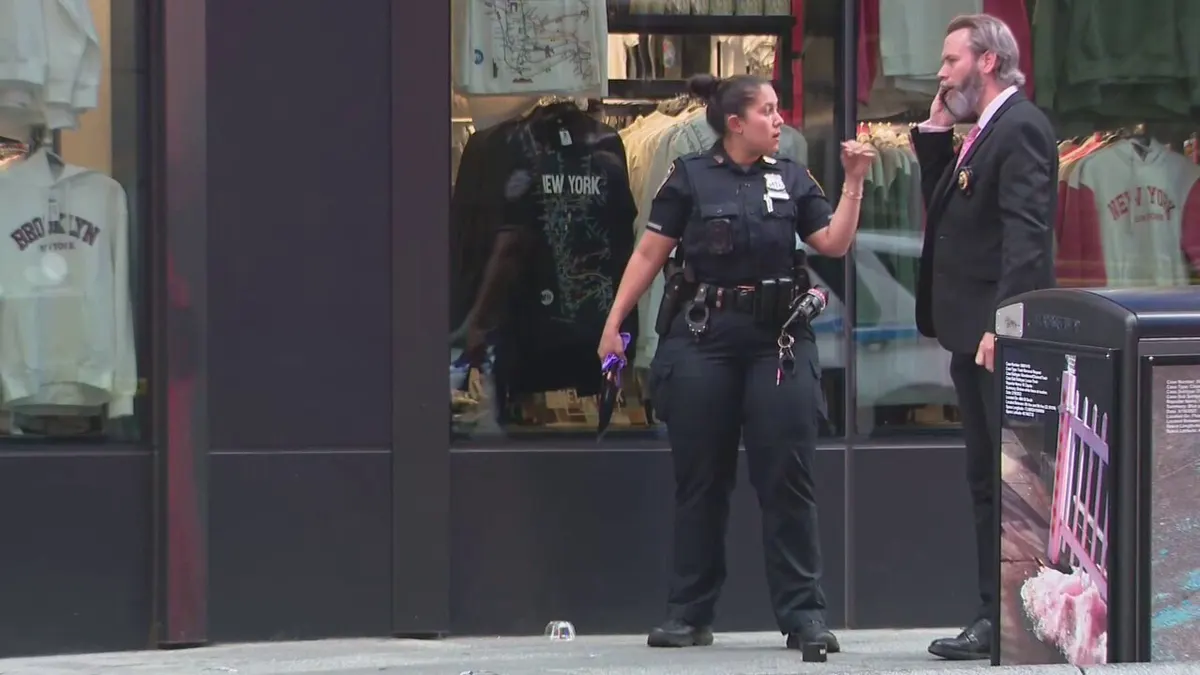
A woman was fatally shot by New York police officers in Times Square on Monday afternoon after she stabbed two bystanders, killing a Bank of America executive and seriously wounding a 68-year-old man. The suspect, Pamela Cisneros Lopez, 49, of Queens, refused to drop the two kitchen knives she was carrying and told officers "I would rather kill both of you" during a brief standoff before she was tasered and then shot as she ran at them. Police said Lopez had a documented history of mental health incidents in 2018 and 2019, though she had never been arrested, and officials found no clear motive for the attack.
Lopez pulled the knives from a shopping bag and first stabbed the 68-year-old man in the abdomen as he waited to cross the street with his wife; he remains in hospital in a stable condition. She then stabbed Erin Piacenti, 32, of Chester, New Jersey, in the abdomen, killing her; Piacenti was Bank of America's vice president of business selection and conflicts and had recently marked her second wedding anniversary. Mayor Zohran Mamdani and Police Commissioner Jessica Tisch praised the responding officers for preventing further casualties in the crowded tourist district, with witnesses describing scenes of panic and bloodshed as bystanders tried to help the victims.
- Woman stabbed two people in Times Square, killing one
- Police shot suspect Pamela Cisneros Lopez, 49, dead
- Victim Erin Piacenti, 32, was a Bank of America executive
New here? Start with this
Woman shot dead by NYPD after fatal Times Square stabbing needs no repeat, so here's the primer.
Times Square is one of the busiest tourist areas in New York City, packed with visitors, shops and street performers at almost any hour. Because of this, any violent incident there tends to draw a large crowd of witnesses and be captured on video within moments, which is why accounts and footage of this event spread quickly.
The people involved were a woman carrying knives, who police say attacked two bystanders, and NYPD officers who were called to the scene. One of those attacked, a female tourist, later died from her injuries, while a male victim was left seriously hurt. Police say they used a taser before resorting to gunfire, after the woman is said to have run at them.
Both sides, in good faith
The strongest fair case each way — we don't pick a winner.
The case for
Advocates of the officers' actions argue that they faced a rapidly unfolding, lethal threat in a crowded public space: a woman had already stabbed two people, one fatally, and after being tasered still charged at armed officers with a large knife. In such split-second circumstances, with bystanders and tourists nearby, officers have a duty to stop an active threat before more people are killed or injured, and less-lethal options had already been tried and failed. Given the immediacy of the danger, this side holds that lethal force was a necessary and proportionate response to protect both the public and the officers themselves.
The case against
Critics who focus on policing of mental health crises argue that the case illustrates the risks of relying on armed officers, rather than trained crisis-intervention or mental health specialists, to respond to an evidently 'emotionally disturbed' individual. They contend that a person in acute psychological distress may not process commands or the threat of tasering rationally, and that repeated incidents of fatal police shootings of knife-wielding, apparently disturbed individuals in New York point to a systemic gap in de-escalation training, resources, and alternative response models. This side values developing approaches that could reduce the likelihood of such encounters ending in death, even while acknowledging the extreme danger officers faced in that moment.
Full account
A woman was shot dead by New York police officers in Times Square on Monday afternoon after she allegedly stabbed two people and then advanced on officers armed with knives, according to authorities. The violence broke out shortly before 4.30pm near the junction of Seventh Avenue and West 42nd/43rd Street, in one of Manhattan's busiest tourist districts, when the woman is said to have stabbed a man and a woman. She then ran north towards a nearby NYPD substation, where she was confronted by a number of officers.
Video footage circulating from the scene reportedly showed the woman holding a large knife in each hand as officers, some with weapons drawn, formed a cordon around her while onlookers scattered and screamed. Witnesses said officers spent several minutes attempting to talk her down and shouting for her to drop the weapons, and that she was struck with a Taser before continuing to advance towards them. Officers then opened fire; accounts of the exact number of shots vary, with one bystander describing two shots while footage described by other outlets suggested as many as five were fired in short bursts as the woman continued to move towards police.
The woman and her two victims were taken to hospital. Accounts of their conditions differ: one report said the suspect and one of the two people she stabbed, described as a female tourist, later died of their injuries, while the second victim remained in a critical condition. Other reporting said only that all three had been hospitalised and that their conditions were not immediately confirmed. Officers were seen beginning CPR on the woman at the scene after apparently realising she had been shot. A large kitchen-style knife was recovered by investigators.
Police said the woman appeared to be emotionally disturbed and, having initially treated the incident as a knifepoint robbery, said they had since found no clear motive for the attack. Authorities stressed that the episode did not appear to be terror-related. It was not immediately confirmed whether any officers were hurt during the confrontation. Police asked members of the public to avoid the West 42nd/43rd Street and Seventh Avenue area amid an ongoing investigation, with a formal briefing expected from the NYPD.
Where outlets differ
Outlets gave slightly different locations for the stabbing — one placed it at West 43rd Street and Seventh Avenue, the other at West 42nd Street and Seventh Avenue.
There is disagreement over the outcome: one report said the incident left the suspect and one victim dead with the other victim critical, while another said all three were simply hospitalised with conditions unconfirmed.
Accounts of how many shots were fired differ — a bystander quoted by one outlet said two shots, while video described elsewhere suggested police fired in two separate bursts totalling around five shots as the woman continued to advance.
One source emphasises police confirmation that the attack was not terror-related and gives a fuller account of the Taser-then-firearm sequence; the other leans more heavily on eyewitness and bystander video descriptions, and notes the incident was initially misreported as a robbery.