Trump’s comments on a united Ireland may have targeted audience across the Atlantic
Developing story first seen 3 hours ago
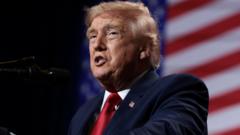
New analysis suggests President Trump's remark that he would "love" to see a united Ireland, made during his two-day Irish visit, may have been aimed at an audience back in the United States rather than at Irish or British observers. With November's US midterm elections approaching and Republicans facing pressure that could cost them control of Congress, commentators suggest Trump may have been courting Irish-American swing voters, a group without a fixed party allegiance that Bill Clinton successfully appealed to during the peace process in the 1990s.
Around one tenth of the US population claims Irish heritage, though they are not a uniform voting bloc, and observers note that Irish America, like the US more broadly, has become far more politically polarised since Clinton's era. Trump repeated his unification comments hours later in a lengthy, rambling speech to business leaders at the US Ambassador's residence in Dublin, which ran to roughly 40 minutes despite being billed as 20, and veered into unrelated domestic US issues including immigration, defence and renewed criticism of the UK. Former Trump envoy Mick Mulvaney and Democratic Congressman Brendan Boyle both maintain the remarks do not signal any change in US policy, with Washington still committed to the Good Friday Agreement.
- Analysts say Trump's unity remarks may target US, not Irish, audience
- Irish-American swing voters seen as key ahead of November midterms
- Officials insist no shift in US policy on Good Friday Agreement
Full account
US President Donald Trump's two-day visit to Ireland was overshadowed on its opening day by unscripted remarks suggesting he would welcome a united Ireland, comments that reverberated across Dublin, Belfast and London. Asked at a joint press appearance with Taoiseach Micheál Martin at Farmleigh House about his personal views on Irish unity, Trump said he would 'love' to see the North and South reunite. He returned to the theme shortly afterwards in a lengthy address to Irish and Irish-American business figures at the US ambassador's residence, this time raising it near the start of his speech, as though aware of the reaction his earlier comment had already provoked.
Reaction on both sides of the Atlantic focused less on whether Trump's underlying prediction was wrong than on what, if anything, it signalled about US policy. Mick Mulvaney, who served as the first Trump administration's special envoy to Northern Ireland, moved quickly to play down the remarks, insisting they did not amount to a change of course and that Washington remained fully behind the Good Friday Agreement. Democratic congressman Brendan Boyle offered a similar assessment, noting the enduring cross-party US backing for that settlement. Both men allowed that Trump might ultimately prove correct that unification would happen 'eventually', while stressing this was a far cry from any active American push in that direction.
Questions were also raised about who the comments were really aimed at. Trump's address to business leaders ran to roughly forty minutes, twice its billed length, and drifted well beyond Irish affairs into a recap of his domestic record on immigration enforcement, trade agreements and defence manufacturing, along with renewed criticism of what he regards as Britain's insufficient backing for his military action against Iran. Given that much of this was being broadcast to American viewers before dawn, and with the US midterm elections looming in November amid pressure on the Republican Party, some observers suggested the true target audience sat in the United States rather than in the room in Dublin, even though Irish-Americans do not vote as a single bloc.
A separate account, citing senior Irish government and US administration sources, offered a more pointed explanation for the episode. According to this reporting, Trump raised the subject of a 'merger' unprompted within minutes of a private meeting with President Catherine Connolly at Áras an Uachtaráin, though Connolly reportedly steered the conversation instead towards the actions of Israeli forces in Gaza rather than engaging on unification. Sources briefed on the visit characterised the president's later public comments as a deliberate, premeditated move rather than a spontaneous aside, describing it as calculated to inflict maximum political discomfort on the British government over its lukewarm support for the Iran strikes. Trump's Irish itinerary, which began with Air Force One's arrival in Dublin under heavy security shortly after 8am, was built around attending the Irish Open at his Doonbeg resort, making the unity remarks an unexpected diplomatic sideshow to what had been billed primarily as a golfing trip.
Where outlets differ
Source 1 (broadcast-style account) frames the remarks as ambiguous in origin — possibly an off-the-cuff answer from a president who enjoys taking questions — and centres on US political reaction (Mulvaney, Boyle) and speculation about a domestic American audience ahead of the midterms.
Source 2 (Mail on Sunday) presents the remarks as deliberate and premeditated, citing government and administration sources who describe a 'well-planned diplomatic assault' intended to damage the UK over its stance on Iran, and adds new detail about an unprompted exchange on unification at the Áras an Uachtaráin meeting with President Connolly, who allegedly redirected the conversation to Gaza.
Source 2 also emphasises that the visit's primary purpose was the Irish Open at Trump's Doonbeg golf resort, with the political meetings framed as a brief prelude, whereas Source 1 treats the diplomatic engagements and speech as the main events of the day.
More coverage