Science news and discussion on TalkFuse.
Two of the Universe’s Great Mysteries May Have Their Own Dimension
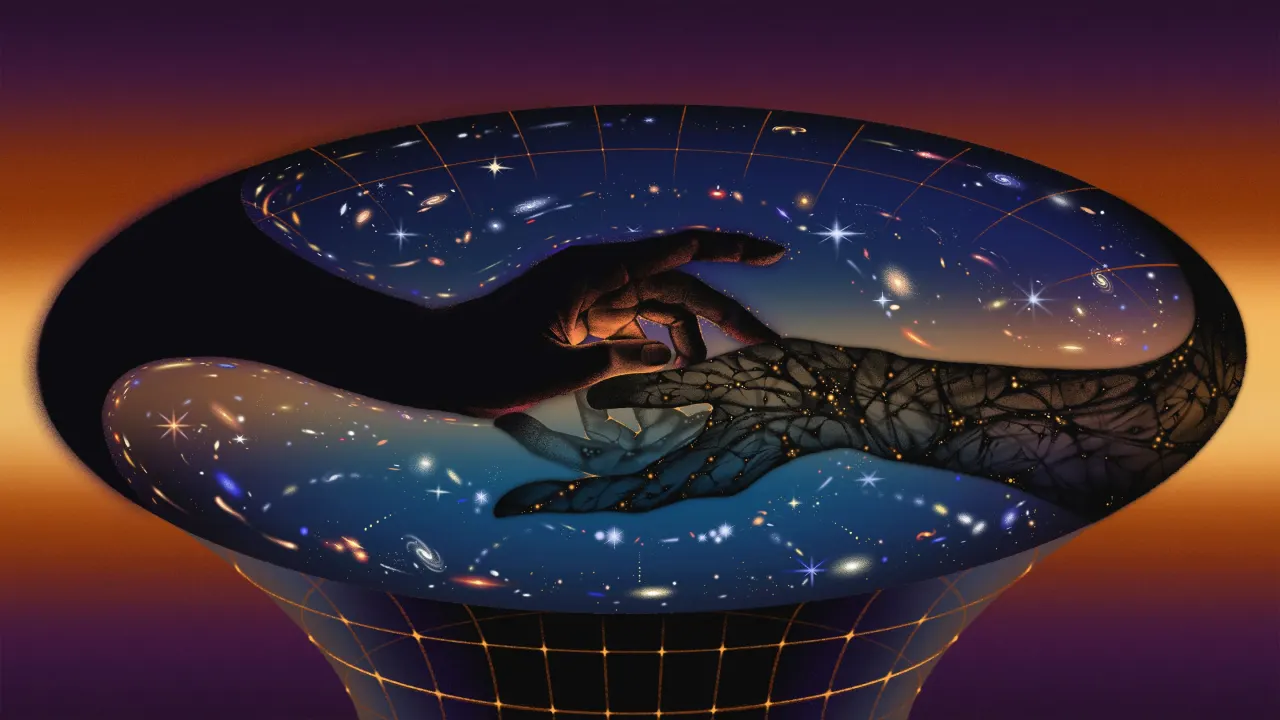
Physicists are increasingly exploring the idea that dark energy and dark matter, long treated as separate cosmic mysteries, may in fact be linked or even manifestations of a single "dark sector" theory. The renewed interest follows observations from the DESI collaboration in 2024, later reinforced by a larger 2025 study, suggesting that dark energy's strength has not been constant but appears to have peaked roughly two billion years ago before weakening, and may even have grown stronger in an earlier era in an apparent breach of energy conservation, a puzzle researchers call the "phantom regime".
Several teams have proposed models in which dark matter and dark energy exchange energy, which could explain the phantom-like behaviour without violating physical laws. Justin Khoury of the University of Pennsylvania first explored such interactions in 2005 and has since built a new model with colleagues based on a dark-sector analogue of quantum chromodynamics. A separate study published in January in Physical Review D, led by Elsa Teixeira of the University of Montpellier, suggests dark matter may have transferred energy to dark energy in the past, easing its braking effect on cosmic expansion and causing the universe to accelerate faster than expected.
In short
- Dark energy's strength may not be constant, new data suggests
- Scientists suspect dark energy and dark matter could be linked
- New models propose the two exchange energy over cosmic history
Steelman: both sides, in good faith
The strongest fair case each way — we don't pick a winner.
The case for
Linking dark matter and dark energy could explain why dark energy appears to have changed over time, while keeping the models consistent with physical laws through an exchange of energy between the two. A shared dark-sector theory may also offer a more unified account of observations that separate explanations have struggled to explain.
The case against
The proposed link remains a theoretical possibility, and the reported observations do not by themselves establish that dark matter and dark energy interact. Their apparent evolution could have other explanations, so combining the two mysteries into one theory may add assumptions before there is enough evidence to distinguish it from alternatives.
Explained simply
Dark matter and dark energy are names for two poorly understood features of the universe. Dark matter cannot be seen directly, but its gravity helps explain how galaxies hold together; dark energy is the name given to whatever is driving the universe’s expansion to speed up.
Scientists have usually studied them as separate problems, but some are exploring whether they interact as parts of a wider “dark sector”. In these models, energy could pass between dark matter and dark energy, changing how each affects the universe.
The question matters because the balance between them shapes how the universe expands over time. If they are linked, that could offer a way to explain observations that are difficult to fit with models in which dark energy stays constant.